
Category: Load Balancing
6-to-4 load balancing is not NAT64
Every time I write about lack of commercial NAT64 products (yeah, I know Juniper had one for a long time and Brocade just rolled out ADX code), someone tells me that company X has field-proven NAT64 product ... only most of them are really 6-to-4 load balancers. Let’s see what the difference is.
Distributed Firewalls: a Ticking Bomb
Are you ever asked to use a layer-2 Data Center Interconnect to implement distributed active-active firewalls, supposedly solving all the L3 issues and asymmetrical-traffic-flow-over-stateful-firewalls problems? Don’t be surprised; I was stupid enough (or maybe just blinded by the L2 glitter) in 2010 to draw the following diagram illustrating a sample use of VPLS services:
Brocade VCS fabric has almost-perfect load balancing
Short summary for differently-attentive: proprietary load balancing Brocade uses over ISL trunks in VCS fabric is almost perfect (and way better for high-throughput sessions than what you get with other link aggregation methods).
During the Data Center Fabrics Packet Pushers Podcast we’ve been discussing load balancing across aggregated inter-switch links and Brocade’s claims that its “chip-based balancing” performs better than standard link aggregation group (LAG) load balancing. Ever skeptical, I said all LAG load balancing is chip-based (every vendor does high-speed switching in hardware). I also added that I would be mightily impressed if they’d actually solved intra-flow packet scheduling.
IPv6-Enabling Your Legacy Applications with F5 BIG-IP LTM
In every enterprise-focused IPv6 presentation, including my Enterprise IPv6 – the first steps webinar, I’m telling the attendees that they can easily make their legacy applications reachable over IPv6 with a little help from F5 load balancers. After all, Facebook is doing exactly that, so it should work (in theory)… but as we all know, in practice, the theory and practice are wildly different.
Load sharing in MPLS/VPN networks with route reflectors
Some of the e-mails and comments I received after writing the “Changing VPNv4 route attributes” post illustrated common MPLS/VPN misconceptions, so it’s worth addressing them in a series of posts. Let’s start with the simplest scenario: load balancingsharing toward a multi-homed customer site. We’ll use a very simple MPLS/VPN network with three customer sites, four CE-routers, four PE-routers a route reflector:
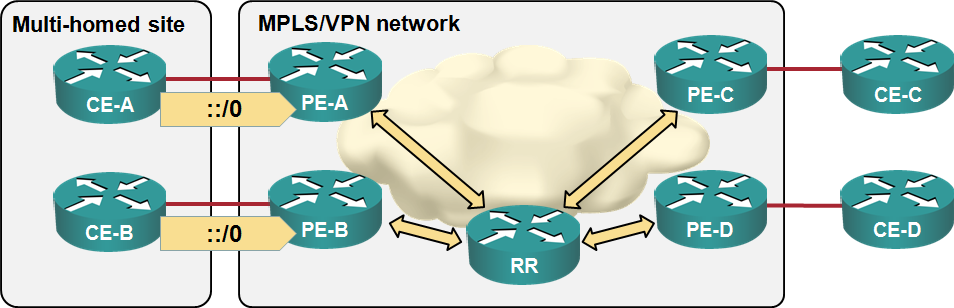
MLAG and Load Balancing
FullMesh added an excellent comment to my Multi-Chassis Link Aggregation (MLAG) and hot potato switching post. He wrote:
If there are two core routing switches and two access switches which are MLAGged together in both directions, and hosts that are dual-active LAGged to the pair of access switches, then the traffic would stay on whichever side the host places it.
He also opened another can of worms: load balancing in MLAG environment is dictated by the end hosts. It doesn’t pay to have fancy switches that support L3 or L4 load balancing; a stupid host implementing destination-MAC-address-based load balancing can easily ruin your day.
Load Sharing 101 (with References)
It looks like my load sharing posts did not paint the whole picture; I’m always assuming the readers have a basic level of IP routing knowledge (somewhere around BSCI/CCNP) and jump into juicy details. Let’s try to fix this error and start from the beginning. For more details, watch the How Networks Really Work webinar.
A router receives its routing information (reachability of IP prefixes) from various sources: connected IP prefixes, static routes and dynamic routing protocols. For every IP prefix, the best source (= one with the lowest administrative distance) is selected and only the route(s) from that source are included in the IP routing table.
… updated on Tuesday, December 29, 2020 07:37 UTC
EBGP Load Balancing with a Multihop EBGP Session
Multihop EBGP sessions are the traditional way to implement EBGP load balancing on parallel links. EBGP session is established between loopback interfaces of adjacent routers (see the next diagram; initial router configurations are included at the bottom of the article) and static routes (or an extra instance of a dynamic routing protocol) are used to achieve connectivity between loopback interfaces (BGP next-hops). The load balancing is an automatic result of the recursive route lookup of BGP next hops.
EBGP Multipath Load Sharing and CEF
When I was discussing the details of the BGP troubleshooting video with one of my readers, he pointed out that I should mention the need for CEF switching in EBGP multipath scenario. My initial response was “Why would you need CEF? EBGP multipath is older than CEF” and his answer told me I should turn on my gray cells before responding to emails: “Your video as well as Cisco’s web site recommends CEF for EBGP multipath design… but interestingly, it does work without CEF”.
Load balancing quirks
One of my readers has noted an interesting load-balancing behavior: when he was running traceroute tests from various routers in a topology similar to the one displayed below, the traceroute outputs indicated per-packet load balancing (both paths were used) when they were initiated from R2 or R3, but used a single path when initiated from R1 or R4.
