
Blog Posts in November 2007
BGP Fast Session Deactivation
We all know that BGP is meant to converge slowly… well, the MPLS/VPN service providers tend to disagree, as their users are not used to minute-long convergence times. One of the major components of slow BGP convergence is the time it takes a router to discover that a neighbor has disappeared. Traditionally, the BGP keepalive packets were sent every minute and it took up to three minutes to discover that a neighbor is down.
Of course you could fine-tune those times with the neighbor timers configuration command, but the reduced timers resulted in increased TCP traffic and consequently increased CPU load, which could reach tens of percents if the timers were set to a few seconds and the router had lots of BGP neighbors.
Configure DNS Servers Through IPCP
After I've fixed the default routing in my home office, I've stumbled across another problem: the two ISPs I'm using for my primary and backup link have DNS servers that reply solely to the DNS requests sent from their own IP address range:
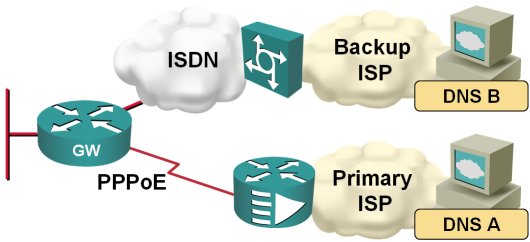
When the traffic is switched from the primary to the backup ISP, I therefore also need to switch the DNS servers. Fortunately, this is quite easy to do on a router; you just need to configure ppp ipcp dns request on the dialer interface and the router starts asking for the DNS server address as part of the IPCP negotiation.
Enhanced show interfaces command
It's amazing how many options (most of them still undocumented) the show interfaces command accepts in IOS release 12.4T (I won't even start guessing when each one was introduced, if you're running old IOS releases, please feel free to comment):
- show interfaces description displays interface names, L1 and L2 status (line and line-protocol status) and interface description. Extremely handy if you want to check which interfaces are up/down.
- show interfaces counters protocol status displays the L3 protocols active on each interface.
- show interfaces summary displays the state of various interface queues and related drop counters in a nice tabular format.
- show interfaces accounting displays per-protocol in/out counters.
Here are a few sample printouts:
Can I combine EEM applets with Tcl shell?
When I’ve been describing the limitations of kron, someone quickly asked an interesting question:
As I cannot insert extra input keystrokes with EEM applet, can I run a Tcl script from it with the action sequence cli command “tclsh script” command and use the typeahead function call to get around the limitation?”
The only answer I could give at that time was “maybe” … and obviously it was time for a more thorough test. The short result is: YES, you can do it (at least in IOS release 12.4(15)T1).
Kron: poor-man's cron
When two groups within Cisco needed time-based command execution in Cisco IOS, they (in a typical big-corporation fashion) decided to implement the same wheel from two different sets of spokes and rims. One group built the Embedded Event Manager with its event timer cron command (introduced in 12.2(25)S and 12.3(14)T), the other group created the more limited kron command set (introduced in 12.3(1)).
Install default route with PPP
In my home office, I'm using DSL access to the Internet with ISDN backup to another ISP, as shown on the next figure:
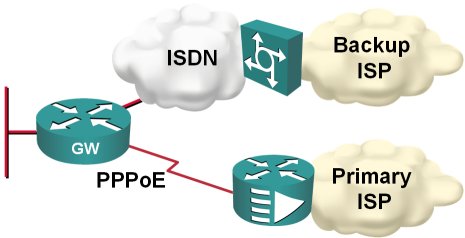
Obviously, I would like the ISDN backup to kick in whenever the primary connection goes down; two static default routes and reliable static routing on the primary default seem like a perfect solution.
Enable password or enable secret?
I've stumbled across a blog post that indicates there's still confusion on some fundamental configuration issues. I will not even try to guess whether there is a wide consensus on how to configure a router, but these are the facts (and here is a ten year old position from Cisco):
- Type-7 encryption used in enable password has been broken. Source code for the decrypt program and cracker programs are available online, or you could use a router to do it for you.
- The type-7 encryption is reversible (and easily breakable due to a weak algorithm), whereas type-5 encryption is a one-way encryption that probably requires a dictionary attack to break.
- Based on the previous two facts, you should never use enable password. Use enable secret.
- The service password-encryption encodes passwords attached to local usernames with type-7 encryption. The usage of type-7 encryption is necessary as you might need the cleartext passwords in some authentication mechanisms (for example, CHAP). However, it's still better to have scrambled passwords than cleartext ones; at least a casual observer will not be able to read them. Conclusion: use service password-encryption.
- If your authentication methods don't need cleartext passwords (examples: local username/password authentication, local AAA authentication or PAP authentication), use username secret configuration command (available from IOS releases 12.2T, 12.3 and 12.0S).
Emulate dialup links with serial lines
I had to figure out various PPP parameters (and associated Cisco IOS behavior) and didn't have real dial-up equipment in my lab setup. I could have gone with PPPoE, but it turned out it's way simpler to emulate dialup connections (at least the PPP negotiations work as expected) on fixed serial lines. This is the minimum setup you need on the “caller” side …
interface Serial1/0
 ip address negotiated
 encapsulation ppp
 ppp authentication pap optional
 ppp pap sent-username client password 0 client
… and this is the “server”-side configuration:
Use BGP Default Route to Replace Static Routing
Martin Kluge sent me an interesting BGP question: he has two upstream links and runs BGP on both. Since his router is low on RAM, he cannot accept full routing, so he’s just announcing his IP prefix and using static default routing toward upstream ISPs.
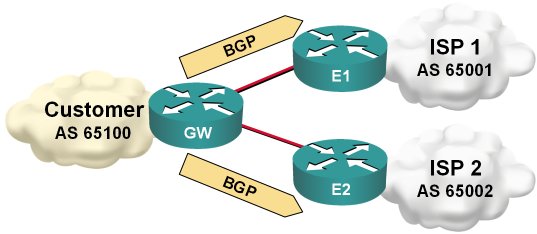
Static default routing toward upstream ISP
Type 7 decryption in Cisco IOS
Tim Riegert sent me an interesting hint: you don't need password crackers to decode type-7 passwords, you just need access to a router. Here's how you do it:
We'll turn on type-7 encryption for local passwords and generate a test username
Show active IOS processes
You can use the show process cpu sorted command in combination with an output filter to display only those IOS processes that consumed noticeable amount of CPU time in the last five minutes, last minute or last five seconds. Use the following patterns to construct your regular expression:
- The [0-9.]+% pattern will match any non-zero percentage;
- The 0.00% pattern will obviously match the zero-percentage display;
- As the percentage figures are separated by various amounts of whitespace characters, we have to use the ' +' pattern to match those;
The show filter should exclude the processes that have the zero percentage in the desired column and any percentage in the other two columns (any other filter would show too many or too few processes). To display processes active in the last minute, use the show process cpu sorted 1min | exclude [0-9.]+% +0.00% +[0-9.]+% command (and define an alias to make it easier to use).
Persistent EEM variables
Someone has asked me a while ago whether it's possible to retain variable values between invocations of an EEM policy. Since a new copy of Tcl interpreter is started for each event, global variables obviously won't work; they are lost as soon as the Tcl policy is finished. A potential solution is to modify the router's configuration and save the values you wish to preserve in event manager environment, but that's a time-consuming process that interferes with whatever router configuration management process you have.
The real solution is based on the appl_setinfo and appl_reqinfo calls. They work, but like many other Tcl-related IOS features they are … well … weird.
Ones Are Slower than Zeroes
Thinking about the implications of bit stuffing I wrote about in the SDLC post, I realized that long sequences of ones would be transmitted slower than long sequences of zeroes due to an extra bit being inserted after every fifth consecutive one. The theory would predict a 20% decrease in transmission speed.
Of course I wanted to test this phenomenon immediately. I connected two routers with a low-speed (64 kbps) link, and started a series of pings. Not surprisingly, the results confirmed the theory:
Routing table profiling
Speaking of Joe Harris … he just wrote a great post about the IP routing table profiling available in Cisco IOS and the ways it can be used to monitor the stability of your network.
Catch Skype with Flexible Packet Matching
Joe Harris published an excellent post detailing how you can use Flexible Packet Matching to recognize (and potentially block) Skype traffic. The solution depends on recognizing the first four bytes sent by the Skype application in a TCP session. While this is a great idea, you have to be aware that there's always a non-zero chance of false positives, more so as the described filter is testing the beginning of the payload in every TCP packet (not just the first data packet in the session).
Back to the roots: it all started with SDLC
My recent post about problems with old modems has generated a lot of comments with some very useful ideas, but nobody addressed the question “why was a long string of ones not a problem?”, so let's start there. Almost all WAN synchronous protocols in use today are descendants of venerable SDLC invented by IBM more than 30 years ago.
SDLC was later extended to support connectionless and balanced modes, resulting in HDLC. PPP is just an extension of HDLC, adding support for negotiations and standard layer-3 protocol demultiplexing.
React to excessive jitter with EEM
William Chu sent me a working configuration he uses to measure jitter with the IP SLA tool and react to excessive jitter on the primary link. First you have to create the jitter probe with the IP SLA commands:
ip sla monitor 3000
 type jitter →
   dest-ipaddr 199.11.18.168 dest-port 12333 →
   source-ipaddr 199.11.18.169 codec g729a →
   codec-numpackets 100
 tos 184
 frequency 10
Note: The continuation character (→) indicates that the configuration command spans multiple lines
For the oldtimers: swamped with zeroes
In the pre-DSL days, you had two options to get a short-haul high-speed link (at least in Europe): take E1 (or fractional E1) from a telecom (which was more expensive than a highway robbery, as the cost was recurring) or use baseband modems with proprietary encoding techniques on physical copper wires (assuming you could get them).
As it turned out, some of these encoding techniques were not as good as the others (but the equipment was relatively cheap, so the budget limits usually forced the decision). We had our own share of modem-related problems, but they were never as bad as what I've heard from one of my students: his modems would lose synchronization when transmitting a long string of zeroes over a regular synchronous serial interface; ping ip 1.2.3.4 size 1000 data 0000 would be enough to bring down the link.
MPLS Traffic Engineering myths
Did you believe MPLS TE was a quality-of-service feature? Did someone persuade you it’s mandatory to run OSPF or IS-IS if you want to deploy MPLS TE? I’ve collected a few more myths like these two and explained the actual facts behind them in 10 MPLS traffic engineering myths and half truths published by ComputerWeekly..
Download router configurations via TFTP
In a previous post, I've described how you can turn your router into a TFTP server. As you can configure the router to serve any file residing on it, you can also pull startup and running configuration from it with TFTP, providing that you configure:
tftp-server nvram:startup-config
tftp-server system:running-config
Warning: Due to total lack of any security features in TFTP protocol, use this functionality only in lab environment.