
Category: Load Balancing
Equal-Cost Multipath in Brocade’s VCS Fabric
Understanding equal-cost multipathing in Brocade’s VCS Fabric is a bit tricky, not because it would be a complex topic, but because it’s a bit counter-intuitive (while still being perfectly logical once you understand it). Michael Schipp tried to explain how it works, Joel Knight went even deeper, and I’ll try to draw a parallel with the routed networks because most of us understand them better than the brave new fabric worlds.
ARP reply with multicast sender MAC address is indeed illegal
A while ago I was writing about the behavior of Microsoft’s Network Load Balancing, the problems it’s causing and how Microsoft tried to hack around them using multicast MAC addresses as the hardware address of sender in ARP replies (which is illegal). A few days ago one of my readers asked me whether I know which RFC prohibits the use of multicast MAC address in ARP replies.
A quick consultation with friendly Google search engine returned this web page, which contained the answer: section 3.3.2 of RFC 1812 (Requirements for IP Version 4 Routers):
LineRate Proxy: Software L4-7 Appliance With a Twist
Buying a new networking appliance (be it VPN concentrator, firewall or load balancer … aka Application Delivery Controller) is a royal pain. You never know how much performance you’ll need in two or three years (and your favorite bean counter will not allow you to scrap it in less than 4-5 years). You do know you’ll never get the performance promised in vendor’s data sheets … but you don’t always know which combination of features will kill the box.
Now, imagine someone offers you a performance guarantee – you’ll always get what you paid for. That’s what LineRate Systems, a startup just exiting stealth mode is promising.
vCider: A Hammer Looking For a Nail?
Last week Juergen Brendel published an interesting blog post describing how you can use vCider to implement high-availability clusters with multi cloud strategy, triggering the following response from one of my readers: “I hadn't heard of vCider before but seeing stuff like this always makes me doubt my sanity – is there really a situation where the only solution is multi-site L2?”
Beware of fabric-wide Link Aggregation Groups
Fernando made a very valid comment to my Monkey Design Still Doesn’t Work Well post: if we would add a few more links between edge and core (fabric) switches to that network, we might get optimal bandwidth utilization in the core. As it turns out, that’s not the case.
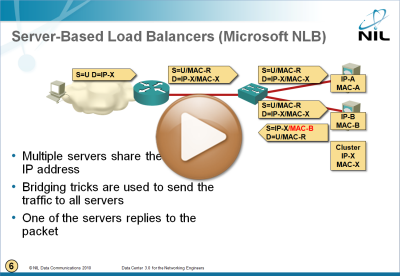
Microsoft Network Load Balancing Behind the Scenes
I figured out I wrote a lot about Microsoft Network Load Balancing (NLB) without ever explaining how that marvel of engineering works. To fix that omission, here’s a short video taken from the Data Center 3.0 webinar.
… updated on Tuesday, November 17, 2020 16:49 UTC
IP Renumbering in Disaster Avoidance Data Center Designs
It’s hard for me to admit, but there just might be a corner use case for split subnets and inter-DC bridging: even if you move a cold VM between data centers in a controlled disaster avoidance process (moving live VMs rarely makes sense), you might not be able to change its IP address due to hard-coded IP addresses, be it in application code or configuration files.
Disaster recovery is a different beast: if you’ve lost the primary DC, it doesn’t hurt if you instantiate the same subnet in the backup DC.
OpenFlow and the State Explosion
While everyone deeply involved with OpenFlow agrees it’s just a low-level tool that can’t solve problems we couldn’t solve in the past (just like replacing Tcl with C++ won’t help you prove P = NP), occasionally you stumble across mindboggling ideas that are so simple you have to ask yourself: “were we really that stupid?” One of them that obviously impressed James Hamilton is the solution to load balancing that requires no load balancers.
Before clicking Read more, watch this video and try to figure out what the solution is and why we’re not using it in large-scale networks.
Do I need IPv6 in my Enterprise (again)
Ethan Banks, one of the masterminds behind the Packet Pushers podcast, wrote a spot-on blog describing why enterprises don’t deploy IPv6. Unfortunately, most of the enterprise networking engineers follow the same line of reasoning, and a few of them might feel like the proverbial deer caught in the headlights once something totally unexpected happen ... like their CEO vacationing in China, getting only IPv6 address on the iPhone, and thus not being able to access a mission-critical craplication. For a longer-term perspective, read an excellent reply written by Tom Hollingsworth.
Multisite Clusters Done Right... by None Other than Microsoft
I had to check the Microsoft clustering terminology a few days ago, so I used Google to find the most relevant pages for “Windows cluster” and landed on the Failover clustering home page where the Multisite Clustering link immediately caught my attention. Dreading the humongous amount of layer-2 DCI stupidities that could lurk hidden behind such a concept, I barely dared to click on the link… which unveiled one of the most pleasant surprises I’ve got from an IT vendor in a very long time.