
Category: Firewall
Building a Greenfield Data Center
The following design challenge landed in my Inbox not too long ago:
My organization is the in the process of building a completely new data center from the ground up (new hardware, software, protocols ...). We will currently start with one site but may move to two for DR purposes. What DC technologies should we be looking at implementing to build a stable infrastructure that will scale and support technologies you feel will play a big role in the future?
In an ideal world, my answer would begin with “Start with the applications.”
Asymmetric MPLS MTU problem
Russell Heilling made a highly interesting observation in a comment to my MPLS MTU challenges post: you could get asymmetric MTUs in MPLS networks due to penultimate hop popping.
Imagine our network has the following topology (drawn with the fantastic tools used by the RFC authors):
S---CE---R1===R2---FW---C
Distributed Firewalls: a Ticking Bomb
Are you ever asked to use a layer-2 Data Center Interconnect to implement distributed active-active firewalls, supposedly solving all the L3 issues and asymmetrical-traffic-flow-over-stateful-firewalls problems? Don’t be surprised; I was stupid enough (or maybe just blinded by the L2 glitter) in 2010 to draw the following diagram illustrating a sample use of VPLS services:
I Don’t Need no Stinking Firewall ... or Do I?
Brian Johnson started a lively “I don’t need no stinking firewall” discussion on NANOG mailing list in January 2010. I wanted to write about the topic then, but somehow the post slipped through the cracks… and I’m glad it did, as I’ve learned a few things in the meantime, including the (now obvious) fact that no two data centers are equal (the original debate had to do with protecting servers in large-scale data center).
First let’s rephrase the provocative headline from the discussion. The real question is: do I need a stateful firewall or is a stateless one enough?
WAF musings ... not again?
Following my obituary for Cisco’s WAF, Packet Pushers did a really great WAF-focused podcast with Raven Alder, appropriately named Saving the Web with Dinky Putt Putt Firewalls. If you have more than a fleeting interest in protecting business web applications, you should definitely listen to it. Just as an aside: when they were recording the podcast, I was writing my To WAF or not to WAF post ... and it’s nice to see we’re closely aligned on most points.
There’s just a bit I’d like to add to their ponderings. What Raven describes is the “proper” (arduous, time-consuming and labor-intensive) use of WAF that we’re used to from the layer-3/4 firewalls: learning what your web application does (learning because the design specs were never updated to reflect reality) and then applying the knowledge to filter everything else (what I sometimes call the fascist mode – whatever is not explicitly permitted is dropped).
To WAF or not to WAF?
Extremely valid comment made by Pavel Skovajsa in response to my “Rest in peace, my WAF friend” post beautifully illustrates the compartmentalized state some IT organizations face; before going there, let’s start with the basic questions.
Do we need WAF ... as a function, not as a box or a specific product? It’s the same question as “do we need virus scanners” or “do we need firewalls” in a different disguise. In an ideal world where all the developers would be security-conscious and there would be no bugs, the answer is “NO”. As we all know, we’re in a different dimension and getting further away from the heavens every time someone utters “just good enough” phrase or any other such bingo-winning slogan.
It’s popular to bash IT vendors’ lack of security awareness (Microsoft comes to mind immediately), but they’re still far ahead of a typical web application developer. At least they get huge exposure, which forces them to implement security frameworks.
Rest in peace, my WAF friend
A few years ago, Cisco bought a company that made application-level firewalls, first an XML-focused product (XML Gateway) that was also able to verify your XML data, later a Web Application Firewall (WAF), which was effectively the XML product with half of the brains ripped out.
I was really looking forward to these products. Layer-3 firewalls cannot protect web sites against application-layer problems like SQL injections or cross-site scripting, so we definitely need something on the application layer and the WAF (and XML Gateway) ran as virtual appliance in VMware, making them ideal for my lab environment. I quickly lost interest after the first cursory contact with the XML Gateway as you could only manage both products with a web-based GUI (and I definitely don’t want to publish blog posts full of screenshots).
FTP: a trip down the memory lane
A while ago I’ve bitterly complained about the FTP protocol design. I have decades-long grudge with FTP. If you’re old enough to remember configuring firewalls before stateful inspection or reflexive access lists became available, you probably know what I’m talking about; if not, here’s the story.
When enterprises started using the Internet 15+ years ago, most desktop FTP clients did not support passive mode (although it was part of the FTP standard). When configuring “firewalls” (one or two routers with long access lists), you had to allow all inbound TCP session to ports higher than 1024 just to support FTP data sessions. No problem ... unless you were using Sun workstations or NetBIOS over TCP (both of them use dynamic server ports above 1024), in which case those services were totally exposed to the Internet.
Tunneling VPNs and Zone-Based Firewalls
Arnold sent me an excellent question yesterday; he bought my Deploying Zone-Based Firewalls book, but found no sample configurations using IPSec VPN. I was able to find a few sample configurations on CCO, but none of them included the self zone. The truly interesting bit of the puzzle is the traffic being received or sent by the router (everything else is self-explanatory if you’ve read my book), so those configurations are not of great help.
Realizing that this is a bigger can of worms than I’ve expected, I immediately fixed the slides in my Choose the Optimal VPN Service webinar, which now includes the security models for GRE, VTI and DMVPN-based VPN services.
Small Steps to Large Complexity
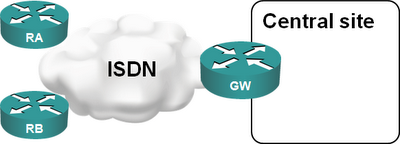
Imagine you have a large retail network: your remote offices use ISDN to dial into the central site and upload/download whatever periodic reports they have. Having a core router connected to an ISDN PRI interface is the perfect solution:
A few years later, ISDN is becoming too slow for your increased traffic needs and you want to replace it with DSL or VPN-over-Internet solution. Your Service Provider offers you PPPoE forwarding with L2TP. This is a perfect solution as it allows you to minimize the changes: