
Install default route with PPP
In my home office, I'm using DSL access to the Internet with ISDN backup to another ISP, as shown on the next figure:
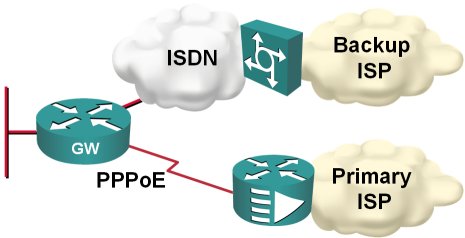
Obviously, I would like the ISDN backup to kick in whenever the primary connection goes down; two static default routes and reliable static routing on the primary default seem like a perfect solution.
Enable password or enable secret?
I've stumbled across a blog post that indicates there's still confusion on some fundamental configuration issues. I will not even try to guess whether there is a wide consensus on how to configure a router, but these are the facts (and here is a ten year old position from Cisco):
- Type-7 encryption used in enable password has been broken. Source code for the decrypt program and cracker programs are available online, or you could use a router to do it for you.
- The type-7 encryption is reversible (and easily breakable due to a weak algorithm), whereas type-5 encryption is a one-way encryption that probably requires a dictionary attack to break.
- Based on the previous two facts, you should never use enable password. Use enable secret.
- The service password-encryption encodes passwords attached to local usernames with type-7 encryption. The usage of type-7 encryption is necessary as you might need the cleartext passwords in some authentication mechanisms (for example, CHAP). However, it's still better to have scrambled passwords than cleartext ones; at least a casual observer will not be able to read them. Conclusion: use service password-encryption.
- If your authentication methods don't need cleartext passwords (examples: local username/password authentication, local AAA authentication or PAP authentication), use username secret configuration command (available from IOS releases 12.2T, 12.3 and 12.0S).
Emulate dialup links with serial lines
I had to figure out various PPP parameters (and associated Cisco IOS behavior) and didn't have real dial-up equipment in my lab setup. I could have gone with PPPoE, but it turned out it's way simpler to emulate dialup connections (at least the PPP negotiations work as expected) on fixed serial lines. This is the minimum setup you need on the “caller” side …
interface Serial1/0
 ip address negotiated
 encapsulation ppp
 ppp authentication pap optional
 ppp pap sent-username client password 0 client
… and this is the “server”-side configuration:
Use BGP Default Route to Replace Static Routing
Martin Kluge sent me an interesting BGP question: he has two upstream links and runs BGP on both. Since his router is low on RAM, he cannot accept full routing, so he’s just announcing his IP prefix and using static default routing toward upstream ISPs.
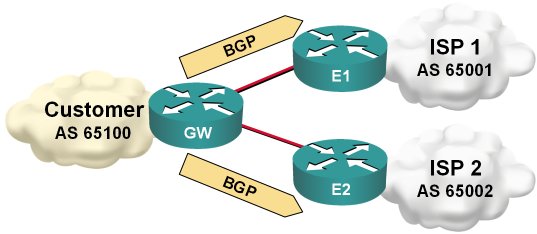
Static default routing toward upstream ISP
Type 7 decryption in Cisco IOS
Tim Riegert sent me an interesting hint: you don't need password crackers to decode type-7 passwords, you just need access to a router. Here's how you do it:
We'll turn on type-7 encryption for local passwords and generate a test username
Show active IOS processes
You can use the show process cpu sorted command in combination with an output filter to display only those IOS processes that consumed noticeable amount of CPU time in the last five minutes, last minute or last five seconds. Use the following patterns to construct your regular expression:
- The [0-9.]+% pattern will match any non-zero percentage;
- The 0.00% pattern will obviously match the zero-percentage display;
- As the percentage figures are separated by various amounts of whitespace characters, we have to use the ' +' pattern to match those;
The show filter should exclude the processes that have the zero percentage in the desired column and any percentage in the other two columns (any other filter would show too many or too few processes). To display processes active in the last minute, use the show process cpu sorted 1min | exclude [0-9.]+% +0.00% +[0-9.]+% command (and define an alias to make it easier to use).
Persistent EEM variables
Someone has asked me a while ago whether it's possible to retain variable values between invocations of an EEM policy. Since a new copy of Tcl interpreter is started for each event, global variables obviously won't work; they are lost as soon as the Tcl policy is finished. A potential solution is to modify the router's configuration and save the values you wish to preserve in event manager environment, but that's a time-consuming process that interferes with whatever router configuration management process you have.
The real solution is based on the appl_setinfo and appl_reqinfo calls. They work, but like many other Tcl-related IOS features they are … well … weird.
Ones Are Slower than Zeroes
Thinking about the implications of bit stuffing I wrote about in the SDLC post, I realized that long sequences of ones would be transmitted slower than long sequences of zeroes due to an extra bit being inserted after every fifth consecutive one. The theory would predict a 20% decrease in transmission speed.
Of course I wanted to test this phenomenon immediately. I connected two routers with a low-speed (64 kbps) link, and started a series of pings. Not surprisingly, the results confirmed the theory:
Routing table profiling
Speaking of Joe Harris … he just wrote a great post about the IP routing table profiling available in Cisco IOS and the ways it can be used to monitor the stability of your network.
Catch Skype with Flexible Packet Matching
Joe Harris published an excellent post detailing how you can use Flexible Packet Matching to recognize (and potentially block) Skype traffic. The solution depends on recognizing the first four bytes sent by the Skype application in a TCP session. While this is a great idea, you have to be aware that there's always a non-zero chance of false positives, more so as the described filter is testing the beginning of the payload in every TCP packet (not just the first data packet in the session).