
MPLS Traffic Engineering without a Link State routing protocol
You've probably heard the joke about the honest salesmen: it's not that they're lying, what they know isn't true. I had a similar problem recently: in the 10 MPLS traffic engineering myths and half truths I wrote “Half-truth: MPLS TE only works with OSPF and IS-IS routing protocols.” Ivan Kuchin understood that as “You can run MPLS TE without OSPF or IS-IS.” Although I haven't written that anywhere, I also thought that was the case … so let me try to weasel out of this mess.
Mandatory EEM CLI commands
The action cli commands used in EEM applets as well as the cli* Tcl functions used in EEM Tcl policies open a virtual Telnet session to a VTY line to execute the CLI commands. The first command you have to execute in the EEM applet is thus the enable command to ensure the next commands will be executed with privilege level 15.
You don't have to specify the enable password.
Likewise, if you want to configure the router, the next command to execute is the configure terminal command, followed by the configuration commands.
BGP fast session deactivation also speeds up session establishment
You might have been there before: the BGP neighbor becomes reachable after you fix a fault in the network, but the BGP session takes “forever” to be established (actually, the hold off is less than a minute, but time is running slower when you are waiting for the network to recover). However, when testing the BGP fast peering session deactivation, I made an interesting discovery: the restart time is improved as well; as soon as the path to the BGP neighbor appears in the IP routing table, the BGP session is established. The debugging printouts from my router are included below (I've used neighbor 10.0.3.3 fall-over configuration command):
Execute CLI commands with prompts in EEM
In response to my post about combining Tcl shell with EEM to get around the “no prompts” limitation of EEM action cli command, Xavier proposed using the undocumented pattern option of the action cli command, which changes the string the EEM script is expecting to indicate that the current command has been executed.
By default, the EEM action cli command waits until it receives exec-level prompt from the VTY (Router> or Router#), resulting in an endless wait and aborted EEM applet in IOS release 12.4(15)T (earlier releases would hang a VTY line forever) if a CLI command returns an additional prompt. With the pattern option, you can change the expected reply to whatever prompt the CLI command is outputting.
BGP without MPLS?
Designing and operating large BGP networks has always been a challenge, as you have to deploy BGP on all core routers and design a hierarchy of internal BGP routers to get around the full-mesh limitation. When MPLS was introduced, it gave us means of deploying BGP only on the network edges, with the core routers carrying just the information about the BGP next hops.
As I know some of you run large networks, could you help me understand what you're using (without giving away too much information, of course):
BGP Fast Session Deactivation
We all know that BGP is meant to converge slowly… well, the MPLS/VPN service providers tend to disagree, as their users are not used to minute-long convergence times. One of the major components of slow BGP convergence is the time it takes a router to discover that a neighbor has disappeared. Traditionally, the BGP keepalive packets were sent every minute and it took up to three minutes to discover that a neighbor is down.
Of course you could fine-tune those times with the neighbor timers configuration command, but the reduced timers resulted in increased TCP traffic and consequently increased CPU load, which could reach tens of percents if the timers were set to a few seconds and the router had lots of BGP neighbors.
Configure DNS Servers Through IPCP
After I've fixed the default routing in my home office, I've stumbled across another problem: the two ISPs I'm using for my primary and backup link have DNS servers that reply solely to the DNS requests sent from their own IP address range:
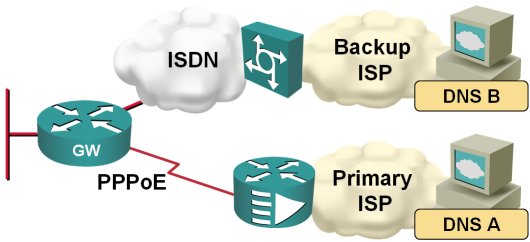
When the traffic is switched from the primary to the backup ISP, I therefore also need to switch the DNS servers. Fortunately, this is quite easy to do on a router; you just need to configure ppp ipcp dns request on the dialer interface and the router starts asking for the DNS server address as part of the IPCP negotiation.
Enhanced show interfaces command
It's amazing how many options (most of them still undocumented) the show interfaces command accepts in IOS release 12.4T (I won't even start guessing when each one was introduced, if you're running old IOS releases, please feel free to comment):
- show interfaces description displays interface names, L1 and L2 status (line and line-protocol status) and interface description. Extremely handy if you want to check which interfaces are up/down.
- show interfaces counters protocol status displays the L3 protocols active on each interface.
- show interfaces summary displays the state of various interface queues and related drop counters in a nice tabular format.
- show interfaces accounting displays per-protocol in/out counters.
Here are a few sample printouts:
Can I combine EEM applets with Tcl shell?
When I’ve been describing the limitations of kron, someone quickly asked an interesting question:
As I cannot insert extra input keystrokes with EEM applet, can I run a Tcl script from it with the action sequence cli command “tclsh script” command and use the typeahead function call to get around the limitation?”
The only answer I could give at that time was “maybe” … and obviously it was time for a more thorough test. The short result is: YES, you can do it (at least in IOS release 12.4(15)T1).
Kron: poor-man's cron
When two groups within Cisco needed time-based command execution in Cisco IOS, they (in a typical big-corporation fashion) decided to implement the same wheel from two different sets of spokes and rims. One group built the Embedded Event Manager with its event timer cron command (introduced in 12.2(25)S and 12.3(14)T), the other group created the more limited kron command set (introduced in 12.3(1)).