
Whose Failure Domain Is It?
Draco made a valid comment to my Keep Your Failure Domain Small post:
What could a small ISP do to limit failure domains? Metro Ethernet and MPLS Virtual Private LAN service are all the rage, and offers customers the promise of being able to connect all their branch offices together, and use the same set of VLANs with free Layer 2 connectivity between their sites. It's either: extend the failure domains, or lose out in selling the service, b/c the customer will buy from another ISP.
Well, your customer’s failure domain doesn’t have to be yours.
Network Automation: Just Do It!
On the very same day that I published the CLI is Not the Problem post I stumbled upon an interesting discussion on the v6ops mailing list. It all started with a crazy idea to modify BGP to use 128-bit router ID to help operators that think they can manually configure large IPv6-only networks without any centralized configuration/management authority that would assign 32 bit identifiers to their routers.
The discussion quickly deteriorated into you really need a provisioning system and in one of the responses Jared Mauch provided a link to a NANOG presentation by Shawn Morris from NTT.
iOS uses Multipath TCP – Does It Matter?
When Apple launched the new release of iOS last autumn, networking gurus realized the new iOS uses MP-TCP, a recent development that allows a single TCP socket (as presented to the higher layers of the application stack) to use multiple parallel TCP sessions. Does that mean we’re getting closer to fixing the TCP/IP stack?
TL&DR summary: Unfortunately not.
Service Insertion with OpenFlow
Another pretty-down-to-Earth OpenFlow use case: service insertion. “Slightly” easier than playing with VLANs or PBR (can you tell how tired I am based on the enormous length of this intro?).
CLI or API? Wait … Do You Really Have to Ask?
The “Is CLI In My Way … or a Symptom of a Bigger Problem” post generated some interesting discussions on Twitter, including this one:
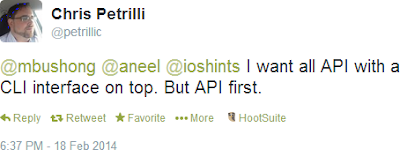
One would hope that we wouldn’t have to bring up this point in 2014 … but unfortunately some $vendors still don’t get it.
This Is Not the Host Route You’re Looking For
When describing Hyper-V Network Virtualization packet forwarding I briefly mentioned that the hypervisor switches create (an equivalent of) a host route for every VM they need to know about, prompting some readers to question the scalability of such an approach. As it turns out, layer-3 switches did the same thing under the hood for years.
VMware NSX Firewall Errata and Updates
Marcos Hernandez sent me a nice list of updates/errata after watching the NSX firewalls video from the VMware NSX Architecture webinar:
iSCSI or FCoE – Flogging the Obsolete Dead Horse?
One of my regular readers sent me a long list of FCoE-related questions:
I wanted to get your thoughts around another topic – iSCSI vs. FCoE? Are there merits and business cases to moving to FCoE? Does FCoE deliver better performance in the end? Does FCoE make things easier or more complex?
He also made a very relevant remark: “Vendors that can support FCoE promote this over iSCSI; those that don’t have an FCoE solution say they aren’t seeing any growth in this area to warrant developing a solution”.
What exactly is SDN (Video)?
The first question I tried to answer (and probably failed to) in the SDN 101 webinar was: What exactly is SDN? Is it an architecture with physically separate centralized control plane, or is it more? Does separate control plane make sense, or is it better to program distributed devices? Watch the video recorded during the live webinar session and tell me whether you agree with my answers.
Comparison of IPv6-over-IPv4 Tunneling Techniques
A while ago Sander Steffann and Iljitsch van Beijnum wrote a fantastic document that compared most (somewhat) widely used IPv6-over-IPv4 tunneling mechanisms. The document got published as RFC 7059 in November and is a definite must-read for anyone having to deal with this particular can of worms.
Unfortunately the document doesn’t cover the recent IPv4 sunset developments – numerous mechanisms that transport IPv4 leftovers over IPv6-only access networks (MAP-E, DS-Lite, lw4over6, 464XLAT …). One can only hope Sander and Iljitsch plan to produce a complementary document soon ;)
Interested in IPv4-to-IPv6 transition mechanisms?
Check out IPv6 Transition Mechanisms webinar and other IPv6 resources on ipSpace.net.
Going All Virtual with Virtual WAN Edge Routers
If you’re building a Greenfield private cloud, you SHOULD consider using virtual network services appliances (firewalls, load balancers, IPS/IDS systems), removing the need for additional hard-to-scale hardware devices. But can we go a step further? Can we replace all networking hardware with x86 servers and virtual appliances?
Published on , commented on July 10, 2022
Is CLI In My Way … or Is It Just a Symptom of a Bigger Problem?
My good friend Ethan recently published a blog post rightfully complaining how various vendor CLIs hamper our productivity. He’s absolutely correct from the productivity standpoint, and I agree with his conclusions (we need a layer of abstraction), but there’s more behind the scenes.
Flow-based Forwarding Doesn’t Work Well in Virtual Switches
I hope it’s obvious to everyone by now that flow-based forwarding doesn’t work well in existing hardware. Switches designed for large number of flow-like forwarding entries (NEC ProgrammableFlow switches, Enterasys data center switches and a few others) might be an exception, but even they can’t cope with the tremendous flow update rate required by reactive flow setup ideas.
One would expect virtual switches to fare better. Unfortunately that doesn’t seem to be the case.
OpenFlow-Based Network Tapping and Tap Aggregation Networks
Network tapping and tap aggregation are obviously the OpenFlow equivalent of the Hello World application – almost every OpenFlow controller vendor has a tap aggregation solution. Does that make sense? Sure – tap aggregation network is outside of the production data path and thus a great candidate for semi-production technology pilots.
For more details, watch the Tap Aggregation Networks video recorded during the Real Life OpenFlow-based SDN Use Cases webinar
Combine Physical and Virtual Appliances in a Private Cloud
I was running fantastic Network Security in a Private Cloud workshops in early 2010s and a lot of the discussions centered on the mission-impossible task of securing existing underdocumented applications, rigidity of networking team and their firewall rules and similar well-known topics.
The make all firewalls virtual and owned by the application team idea also encountered the expected resistance, but enabled us to start thinking in more generic terms.