
Free Webinars and Videos Are Now Easier to Spot
Another summer break project: replacing the stars next to webinar names in descriptions of various technology areas (example: Data Center) with something more useful. Turns out that marking the webinar title as being Free or having Free items works really well.
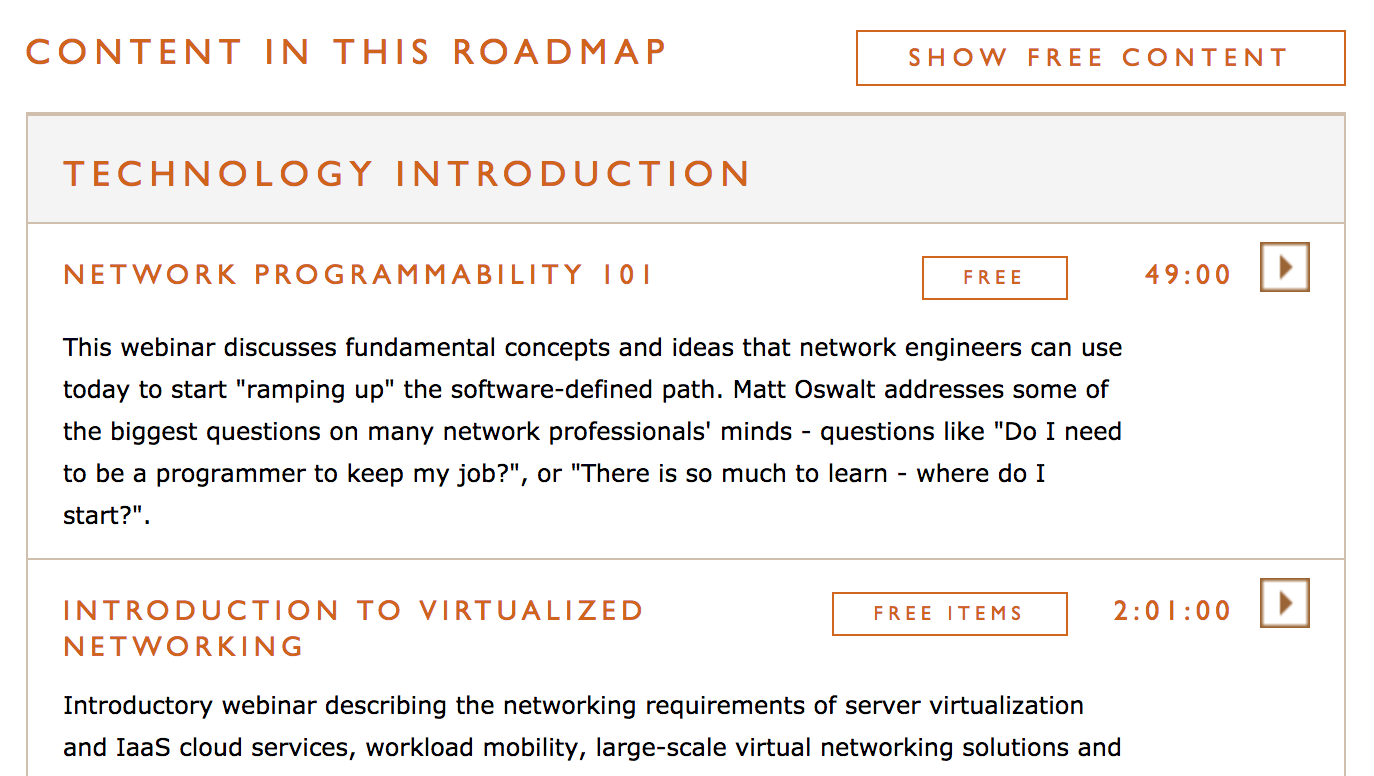
Bonus feature: clicking on show free content shows you the content available with free subscription.
During the summer break, I’m publishing blog posts about the projects I’m working on. Regular blog posts will return in autumn.
Review: Ansible for Networking Engineers
An engineer attending Ansible for Networking Engineers online course sent me this feedback:
This is a great place to learn Ansible and Network Automation from scratch. Starting with an emphasis on the fundamentals (YAML, JSON, Jinja2, how to group your network devices for automation, etc.) you progressively build up towards useful network automation.
He particularly liked the additional features that are part of any ipSpace.net online course:
Goodbye, content.ipspace.net
It turns out that while I cannot bring myself to writing or creating other content during the summer break, it feels perfectly fine to be a janitor and fix small things on the web site.
One of the long-outstanding items: get rid of the free content web site that never went where I wanted it to go… one can do only so much in 24 hours. All the features available on content.ipspace.net are now part of the main ipSpace.net web site including pointers to free content and list of free presentations.
Feedback: Data Center Infrastructure for Networking Engineers
When I created the Data Center Infrastructure for Networking Engineers webinar, I wanted to reach these goals:
- Understand the data center acronym soup;
- Build a conceptual framework of the data center technologies and solutions.
Every now and then I get feedback from a happy attendee telling me how the webinar helped them. Here’s what I got earlier this month:
IOS Adventures: Save the Princess
Want to become Captain Catalyst and save Princess Cattools from the Junipers tribe that invaded IOS Kingdom? Alexander Harsbo created an IOS Adventures game that will keep you busy should you get bored at the beach.
Enjoy ;)
Network Infrastructure as Code in Network Automation Online Course
In mid-May, I ran an onsite network automation workshop, and the manager organizing the workshop for his team invited me to a dinner with his peers. Not surprisingly, they wanted to hear about the topics covered in the workshop, and as soon as I mentioned Network-Infrastructure-as-Code several of them said “yes, that definitely needs to be covered.”
Book: EVPN in Data Center
The EVPN in the Data Center book by Dinesh Dutt, the author of EVPN Technical Deep Dive webinar and member of ipSpace.net ExpertExpress team has finally been published. It’s kept safe behind NVIDIA regwall; you can also access it through the O’Reilly website.
Time for a Summer Break
So many things have happened since I wrote “this is what we’re going to do in 2018” blog post. We ran
- An automation course and a data center course, resulting in three new modules in the automation course, and over 20 hours of fresh content
- Three workshops, two of them brand new and resulting in material for VMware NSX Deep Dive and AWS Networking webinars (both coming in early autumn).
We also did a ton of webinars:
Upcoming Webinars and Events: Autumn 2018
On Tuesday I had the last webinar in spring 2018. One more online course session and it will be time for long summer break. In the meantime, we’re already planning the autumn events:
- We’ll start with Lean Start in Network Automation workshop in Zurich, Switzerland, on August 30th. Register here.
- Building Network Automation Solutions online course starts on September 20th.
We also have the first webinars scheduled:
- We’ll start with two introductory webinars: SDDC 101 on August 28th and SD-WAN Overview on September 4th.
- The first session of technical deep dive into VMware NSX will be on September 11th.
- Amazon Web Service Networking workshop was a huge success, and we’ll turn it into a webinar in early October.
- There will be an interesting math-focused webinar on October 8th;
- Dinesh Dutt will talk about fabric troubleshooting in mid-November;
You can attend all these webinars with an ipSpace.net webinar subscription.
Worth Reading: Fake News in IT
Stumbled upon “Is Tech News Fake” article by Tom Nolle. Here’s the gist of his pretty verbose text:
When readers pay for news, they get news useful to readers. When vendors pay, not only do the vendors get news they like, the rest of us get that same story. It doesn’t mean that the story being told is a lie, but that it reflects the view of an interested party other than the reader.
High-quality content is not cheap, so always ask yourself: who’s paying for the content… and if it’s not you, you may be the product.