
Category: worth reading
Dynamic Path MTU Discovery in Cloudflare One Client
Here’s an interesting tidbit from the what took them so long department: Cloudflare One Client continuously measures end-to-end MTU and adjusts the local tunnel interface MTU size accordingly (warning: there’s a fair amount of dubious handwaving over the interesting details), generating ICMP packet-too-big messages as close to the source as possible.
I managed to avoid VPN clients most of my life, so I have no idea whether this is a “finally someone figured that out 🎉” moment or a late catch-up to what other VPN clients have been doing for ages. Feedback (in comments or otherwise) would be most welcome!
Worth Reading: Faster than Dijkstra?
Bruce Davie published a nice article explaining why it makes little sense to use an algorithm that’s supposedly faster than Dijkstra’s in link-state routing protocols.
Other interesting data points from the article (and linked presentations):
- People are running (a few) thousands of routers in a single area
- Running Dijkstra’s algorithm on an emulated network with 2000 nodes took 100 msec… in 2003 (page 18 of this NANOG presentation).
It turns out (as I expected) that all the noise about the need for new routing protocols we were experiencing a few years ago was either due to bad implementations or coming from nerds looking for new toys to play with.
Interesting: Open Space Events
Following a link in another Martin Fowler’s blog post, I stumbled upon his thoughts on Open Space events – a way to set up self-organizing events.
I’m not sure I’m brave (or young) enough to try it out, but if you’re planning to organize a small gathering (like a local Network Operator Group), this might be an interesting, slightly more structured approach than a Net::Beer event. It would also be nice to know whether someone managed to pull it off in an online format.
Worth Reading: Modern Forwarding Architectures
Ignoring the obligatory misguided mention of OpenFlow and a few other unicorns, I found this article to be a nice introduction to modern forwarding architectures, including networking infrastructure for AI clusters and distributed cell-based fabrics.
Open-Source Network Simulators (2026 Edition)
Brian Linkletter published an updated overview of open-source network simulators and emulators.
containerlab and GNS3 are clear leaders (no surprise there) with the original vrnetlab becoming abandonware (fortunately, we have Roman Dodin’s fork), which makes me think we should focus on using netlab primarily with containerlab and slowly sunset the Vagrant support, particularly considering some people actively hate the license change.
Also, if anyone feels like writing an interface (provider module) between netlab and GNS3, the pull request would be most welcome 😎
Any thoughts? Please leave a comment!
OMG, After a Decade, VXLAN Is Still Insecure
In 2017 (over eight years ago), I was making fun of the fact that “VXLAN is insecure” was news to some people. Obviously, the message needed to be repeated, as the same author gave a very similar presentation two years later at a security conference.
Unfortunately, it seems that everything old is new again (see also RFC 1925 rules 4 and 11), as proved by a “Using GRE and VXLAN for Fun and Profit” (my summary) presentation at DEFCON 33. Even if you knew that unencrypted tunnels are insecure (duh!) for decades, you might still want to read the summary of the talk (published on APNIC blog) and view the slides.
Worth Reading: A Tech Career in 2026
There’s no “networking in 20xx” video this year, so this insightful article by Anil Dash will have to do ;) He seems to be based in Silicon Valley, so keep in mind the Three IT Geographies, but one cannot beat advice like this:
So much opportunity, inspiration, creativity, and possibility lies in applying the skills and experience that you may have from technological disciplines in other realms and industries that are often far less advanced in their deployment of technologies.
As well as:
This too shall pass. One of the great gifts of working in technology is that it’s given so many of us the habit of constantly learning, of always being curious and paying attention to the new things worth discovering.
Hope you’ll find it helpful and at least a bit inspiring.
MUST WATCH: BGP: the First 18 Years
If you’re at all interested in the history of networking, you simply MUST watch the BGP at 18: Lessons In Protocol Design lecture by Dr. Yakov Rekhter recorded in 2007 (as you can probably guess from the awful video quality) (HT: Berislav Todorovic via LinkedIn).
Happy Holidays and All the Best in 2026!
They say time goes faster as you get older, and it seems to be true. Another year has (almost) gone by.
Try to disconnect from the crazy pace of the networking world, forget the “vibe coding with AI will make engineers obsolete” stupidities (hint: Fifth Generation Languages and Natural Language Programming were all the rage in the 1980s and 1990s), and focus on your loved ones. I would also like to wish you all the best in 2026!
In the meantime, I’m working on weaning netlab off of a particular automation tool (you can always track the progress on GitHub). Expect the first results in the January netlab release.
Hilarious: HTTP Status Codes as Pizza Images
Want to look up various HTTP status/error codes when troubleshooting a DNS BGP network server problem? Start at http.pizza for badly-needed stress relief (HT: Networking Notes), then start a chat session with your new AI friend exploring more focused resources like the Wikipedia list of HTTP status codes.
Evergreen: The Big Ball of Mud
In 2007, Jeff Atwood published a legendary blog post summarizing a 1997 paper by Brian Foote and Joseph Yoder.
Reading that blog post (or the original paper), the inevitable conclusion is that we haven’t made much progress in the last 20 years. Even worse, almost every single pathological architecture described in that blog post applies quite well to real-life organically grown networks.
Technical Writing: Lower Your Expectations
Sean Goedecke published an excellent set of recommendations for good technical writing, including:
- Keep it short
- Try to make your point in the first sentence
- Details matter less than you think.
Based on some emails I received in the past (and the lack of response to the lengthy emails I sent), we should apply the same rules to emails (and all other forms of technical communication).
Worth Watching: AI/ML Data Center Design
What could be better than watching 0x02 Jeffs discuss networking? How about having Petr Lapukhov of the RFC 7938 fame as a guest discussing AI/ML Data Center Design?
Note: Petr disappeared into the information black hole called Facebook over a decade ago, so I wondered how they allowed him to chat on a podcast for hours. It turns out he moved to NVIDIA, which might influence the podcast content a bit, but I’m pretty sure Petr is still Petr ;)
Fun Reading: From XML to LLMs
In his latest blog post (Systems design 3: LLMs and the semantic revolution), Avery Pennarun claims that LLMs might solve the problem we consistently failed to solve on a large scale for the last 60 (or so) years – the automated B2B data exchange.
You might agree with him or not (for example, an accountant or two might get upset with hallucinated invoice items), but his articles are always a fun read.
Testing IP Multicast with netlab
Aleksandr Albin built a large (almost 20-router) lab topology (based on an example from Jeff Doyle’s Routing TCP/IP Volume 2) that he uses to practice inter-AS IP multicast. He also published the topology file (and additional configuration templates) on GitHub and documented his experience in a LinkedIn post.
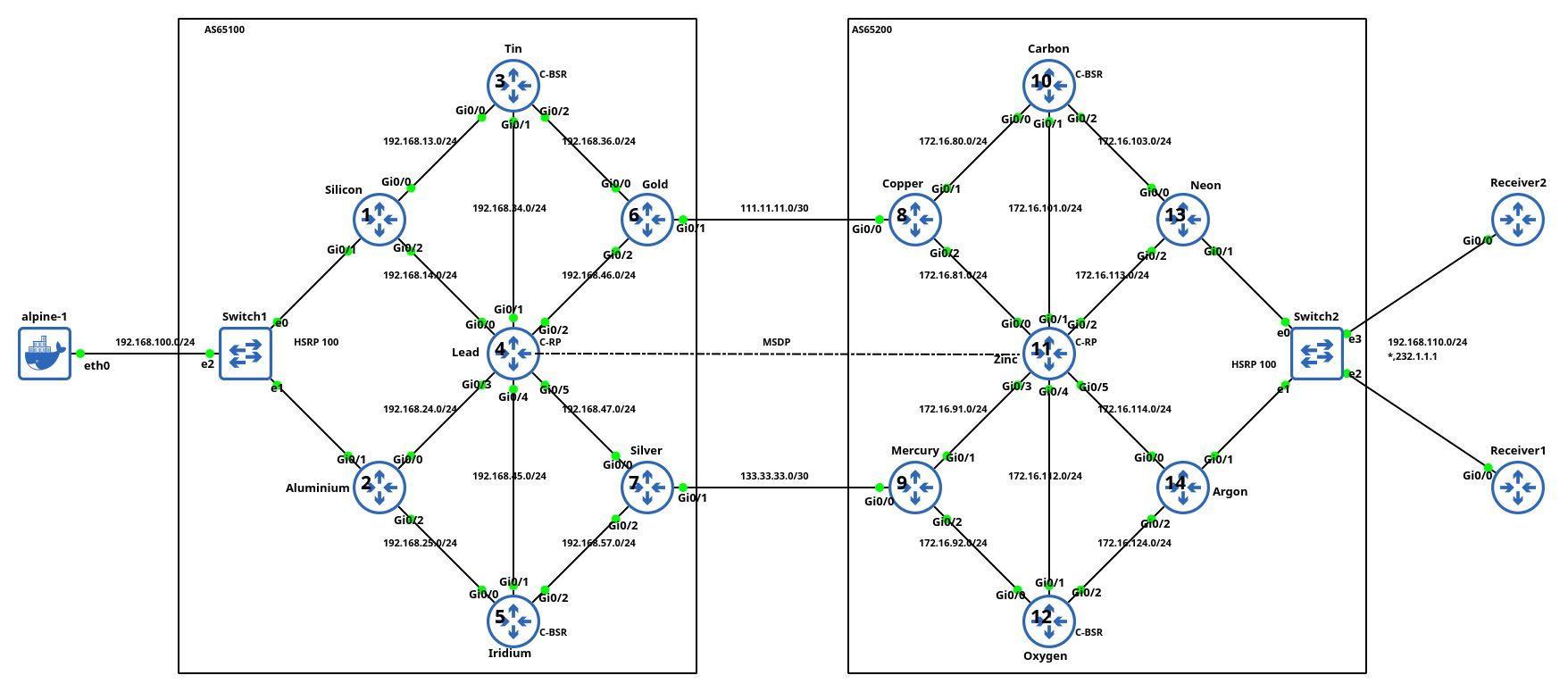
Lab topology, copied with permission by Aleksandr Albin
It’s so nice to see engineers using your tool in real-life scenarios. Thanks a million, Aleksandr, for sharing it.