
Category: Security
Another security product killed
We all knew MARS is becoming a dead end (Cisco first removed third-party support and then stopped developing the product), now it’s official. MARS is dead.
Just in case you haven’t noticed, this is the third security product (after WAF and XML Gateway) Cisco has killed this year. Are they implementing borderless networks or trimming down to core competences while preparing for onslaught of market adjacencies?
Chinese BGP incident: was it a traffic hijack?
You’re probably familiar with the April fat fingers incident in which Chinanet (AS 23724) originated ~37.000 prefixes for about 15 minutes. The incident made it into the annual report of US Congress’ U.S.-China Economic and Security Review Commission (page 243 of this PDF) and the media was more than happy to pick it up (Andree Toonk has a whole list of links in his blog post). We might never know whether the misleading statements in the report were intentional or just a result of clueless technical advisors, but the facts are far away from what they claim:
Data Center Interconnect (DCI) encryption
Brad sent me an interesting DCI encryption question a while ago. Our discussion started with:
We have a pair of 10GbE links between our data centers. We talked to a hardware encryption vendor who told us our L3 EIGRP DCI could not be used and we would have to convert it to a pure Layer 2 link. This doesn't make sense to me as our hand-off into the carrier network is 10GbE; couldn't we just insert the Ethernet encryptor as a "transparent" device connected to our routed port ?
The whole thing obviously started as a layering confusion. Brad is routing traffic between his data centers (the long-distance vMotion demon hasn’t visited his server admins yet), so he’s talking about L3 DCI.
The encryptor vendor has a different perspective and sent him the following requirements:
Setting access lists with RADIUS
Chris sent me an interesting challenge a few days ago: he wanted to set inbound access lists on virtual access interfaces with RADIUS but somehow couldn’t get this feature to work.
Uncle Google quickly provided two documents on Cisco.com: an older one (explaining the IETF attributes, vendor-specific attributes and AV-pairs) and the most recent one (with more attributes and less useful information) covering every Cisco IOS software release up to 12.2 (yeah, it looks like the RADIUS attributes haven’t been touched in a long time). According to the documentation, attribute #11 as well as AV-pairs ip:inacl/ip:outacl and lcp:interface-config should work, but the access list did not appear in the interface configuration.
I Don’t Need no Stinking Firewall ... or Do I?
Brian Johnson started a lively “I don’t need no stinking firewall” discussion on NANOG mailing list in January 2010. I wanted to write about the topic then, but somehow the post slipped through the cracks… and I’m glad it did, as I’ve learned a few things in the meantime, including the (now obvious) fact that no two data centers are equal (the original debate had to do with protecting servers in large-scale data center).
First let’s rephrase the provocative headline from the discussion. The real question is: do I need a stateful firewall or is a stateless one enough?
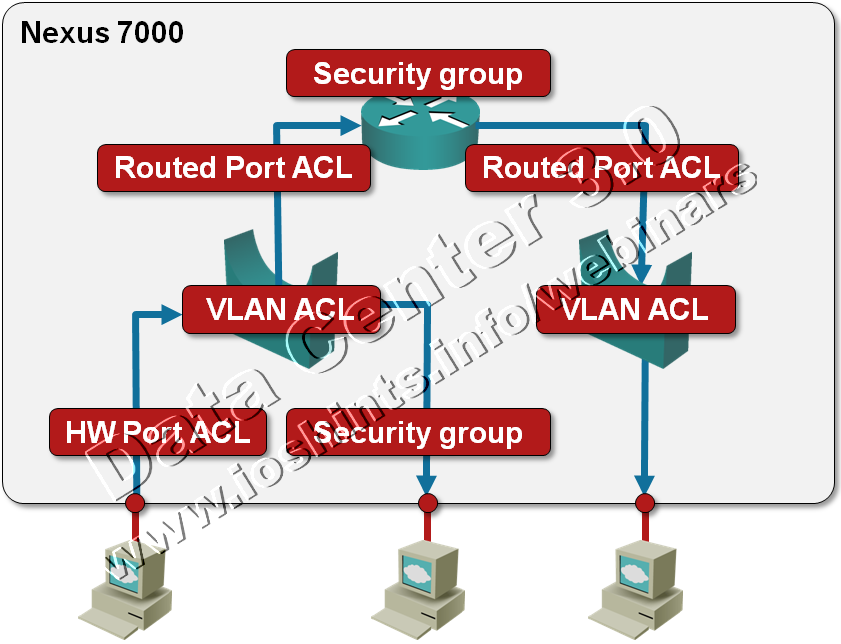
Packet Filters on a Nexus 7000
We’re always quick to criticize ... and usually quiet when we should praise. I’d like to fix one of my omissions: a few days ago I was trying to figure out whether Nexus 7000 supports IPv6 access lists (one of the presentations I was looking at while researching the details for my upcoming Data Center webinar implied there might be a problem) and was pleasantly surprised by the breadth of packet filters offered on this platform. Let’s start with a diagram.
To WAF or not to WAF?
Extremely valid comment made by Pavel Skovajsa in response to my “Rest in peace, my WAF friend” post beautifully illustrates the compartmentalized state some IT organizations face; before going there, let’s start with the basic questions.
Do we need WAF ... as a function, not as a box or a specific product? It’s the same question as “do we need virus scanners” or “do we need firewalls” in a different disguise. In an ideal world where all the developers would be security-conscious and there would be no bugs, the answer is “NO”. As we all know, we’re in a different dimension and getting further away from the heavens every time someone utters “just good enough” phrase or any other such bingo-winning slogan.
It’s popular to bash IT vendors’ lack of security awareness (Microsoft comes to mind immediately), but they’re still far ahead of a typical web application developer. At least they get huge exposure, which forces them to implement security frameworks.
Rest in peace, my WAF friend
A few years ago, Cisco bought a company that made application-level firewalls, first an XML-focused product (XML Gateway) that was also able to verify your XML data, later a Web Application Firewall (WAF), which was effectively the XML product with half of the brains ripped out.
I was really looking forward to these products. Layer-3 firewalls cannot protect web sites against application-layer problems like SQL injections or cross-site scripting, so we definitely need something on the application layer and the WAF (and XML Gateway) ran as virtual appliance in VMware, making them ideal for my lab environment. I quickly lost interest after the first cursory contact with the XML Gateway as you could only manage both products with a web-based GUI (and I definitely don’t want to publish blog posts full of screenshots).
DNSSEC ... finally!
It looks like the signed DNS root zone might finally get deployed on July 15th and Geoff Huston celebrates the fact with a lengthy article on DNSSEC. Just in case you’re not aware what DNSSEC is all about, he’s providing this nifty summary:
A succinct summary of the problem that DNSSEC is intended to address is that DNSSEC is intended to protect DNS clients from believing forged DNS data.
Book review: Securing the Borderless Network
When Cisco started preaching about Borderless Networks a few months ago, we all knew the term Borderless Networks was a new fuzzily-defined paradigm revolving around the facts that:
- People want to use their smartphones (and other mobile devices) to access the corporate data from anywhere at any time.
- Employees have started to use third-party cloud services with unproven security or reliability without coordination with corporate IT or Security.
However, when Cisco Press launched the Securing the Borderless Network book (with the subtitle Security for the Web 2.0 World), I was hoping to get some insight into what Cisco really means with the Borderless Networks paradigm. I was also expecting some hard technical facts and solutions for the problems pestering all of us.