
Category: OpenFlow
The First Glimpse of Open Daylight
Operating systems are boring (for most people); it’s the applications that make everyone excited. SDN is no different. Controllers are boring – someone has to reinvent all the wheels that the networking vendors have been inventing for the last 30 years before you can develop the sexy stuff ... but not many people outside of ivory towers would start developing the (supposedly) sexy SDN apps until being sure the underlying platform will not disappear into thin air.
The Many Paths to SDN
I did a major overhaul of my RIPE 65 SDN presentation prior to MENOG 12 meeting, including a more comprehensive overview of SDN-related technologies sorted by the networking device plane they operate on.
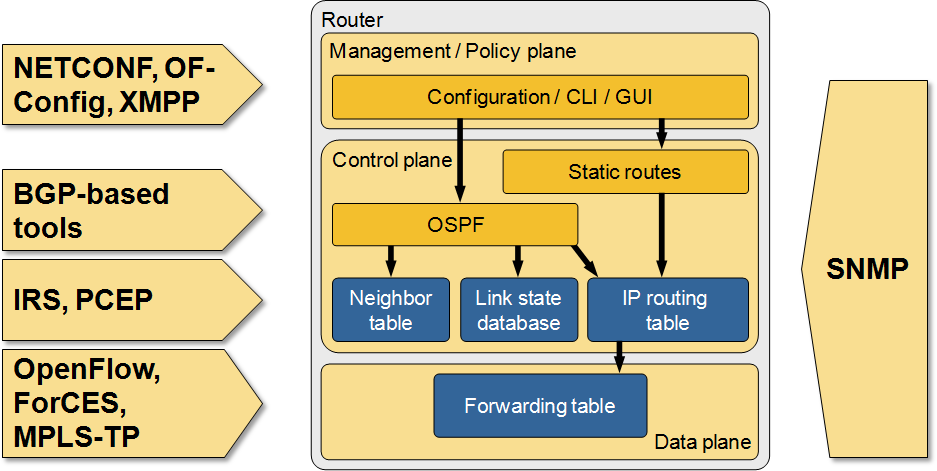
Many paths to SDN
Control-plane policing in OpenFlow networks
The Controller-Based Packet Forwarding in OpenFlow Networks post generated the obvious question: “does that mean we need some kind of Control-Plane Protection (CoPP) in OpenFlow controller?” Of course it does, but things aren’t as simple as that.
ProgrammableFlow Configuration Interfaces
Like every recently designed fabric configuration/management platform, NEC ProgrammableFlow controller supports numerous configuration interfaces, including CLI, GUI, web-based configuration, REST API and OpenStack plugin. For more details, watch this part of the ProgrammableFlow Technical Deep Dive webinar.
Controller-Based Packet Forwarding in OpenFlow Networks
One of the attendees of the ProgrammableFlow webinar sent me an interesting observation:
Though there is separate control plane and separate data plane, it appears that there is crossover from one to the other. Consider the scenario when flow tables are not programmed and so the packets will be punted by the ingress switch to PFC. The PFC will then forward these packets to the egress switch so that the initial packets are not dropped. So in some sense: we are seeing packet traversing the boundaries of typical data-plane and control-plane and vice-versa.
He’s absolutely right, and if the above description reminds you of fast and process switching you’re spot on. There really is nothing new under the sun.
NEC ProgrammableFlow Scalability Features
Once you get rid of spanning tree and associated kludges (not too hard in OpenFlow-based networks), BUM flooding becomes your biggest enemy. NEC’s engineers implemented some interesting features in the ProgrammableFlow switches and controllers: rate-limiting of unknown unicast frames, flooding control, and ARP snooping (if only they’d go for ARP proxy).
Quality of Service in ProgrammableFlow Networks
OpenFlow is not exactly known for its quality-of-service features (hint: there are none), but as I described in the ProgrammableFlow Technical Deep Dive webinar NEC implemented numerous OpenFlow extensions in their edge switches and the ProgrammableFlow controller to give you a robust set of QoS features.
Virtual Tenant Networks with NEC ProgrammableFlow
Virtual tenant networks are one of the best features of NEC ProgrammableFlow solution – you can build virtual layer-2 subnets (based on VLANs, edge ports or port/VLAN combos), connect them with a virtual router, and implement packet filters and traffic steering ... while treating the whole data center fabric as a single device.
Even better, the ingress edge switch performs all the operations you configure (ACLs, L2 lookup, L3 lookup, source/destination MAC rewrite), resulting in optimal end-to-end forwarding.
Daylight – Internet Explorer or Linux of the SDN World?
You’ve probably heard that the networking hardware vendors decided to pool resources to create an open-source OpenFlow controller. Just in case you’re wondering whether they lost their mind (no, they didn’t), here’s my cynical take.
NEC ProgrammableFlow Principles - Q & A
The ProgrammableFlow Principles of Operations section of the ProgrammableFlow Technical Deep Dive webinar generated tens of questions from the audience – it took us almost 20 minutes to answer all of them (note: you might watch the answers after watching the section that triggered the questions).