
Worth Reading: Resolverless DNS
Geoff Huston published a lengthy article (as always) describing talks from recent OARC meeting, including resolver-less DNS and DNSSEC deployment risks.
Definitely worth reading if you’re at least vaguely interested in the technology that supposedly causes all network-related outages (unless it’s BGP, of course)
Worth Reading: Another Hugo-Based Blog
Bruno Wollmann migrated his blog post to Hugo/GitHub/CloudFlare (the exact toolchain I’m using for one of my personal web sites) and described his choices and improved user- and author experience.
As I keep telling you, always make sure you own your content. There’s absolutely no reason to publish stuff you spent hours researching and creating on legacy platforms like WordPress, third-party walled gardens like LinkedIn, or “free services” obsessed with gathering visitors’ personal data like Medium.
Video: Exposing Kubernetes Services to External Clients
After a brief introduction of Kubernetes service and an overview of services types, Stuart Charlton added the last missing bit: how do you expose Kubernetes services to external clients.
Multihoming Cannot Be Solved within a Network
Henk made an interesting comment that finally triggered me to organize my thoughts about network-level host multihoming1:
The problems I see with routing are: [hard stuff], host multihoming, [even more hard stuff]. To solve some of those, we should have true identifier/locator separation. Not an after-thought like LISP, but something built into the layer-3 addressing architecture.
Proponents of various clean-slate (RINA) and pimp-my-Internet (LISP) approaches are quick to point out how their solution solves multihoming. I might be missing something, but it seems like that problem cannot be solved within the network.
BGP in ipSpace.net Design Clinic
The ipSpace.net Design Clinic has been running for a bit over than a year. We covered tons of interesting technologies and design challenges, resulting in over 13 hours of content (so far), including several BGP-related discussions:
- BGP route servers
- Redundant BGP-Based Internet Access
- Secure BGP Configuration on Customer Routers
- Enterprise WAN Routing Design
All the Design Clinic discussions are available with Standard or Expert ipSpace.net Subscription, and anyone can submit new design/discussion challenges.
BGP Unnumbered Duct Tape
Every time I mention unnumbered BGP sessions in a webinar, someone inevitably asks “and how exactly does that work?” I always replied “gee, that’s a blog post I should write one of these days,” and although some readers might find it long overdue, here it is ;)
We’ll work with a simple two-router lab with two parallel unnumbered links between them. Both devices will be running Cumulus VX 4.4.0 (FRR 8.4.0 container generates almost identical printouts).
netlab VXLAN Router-on-a-Stick Example
In October 2022 I described how you could build a VLAN router-on-a-stick topology with netlab. With the new features added in netlab release 1.41 we can do the same for VXLAN-enabled VLANs – we’ll build a lab where a router-on-a-stick will do VXLAN-to-VXLAN routing.
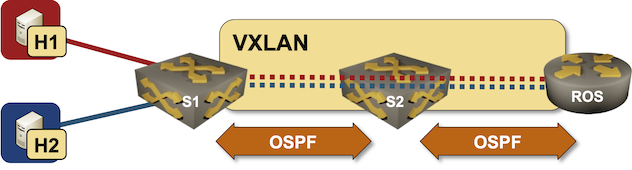
Lab topology
Worth Reading: History of Fiber Optics Cables
Geoff Huston published a fantastic history of fiber optics cables, from the first (copper) transatlantic cable to 2.2Tbps coherent optics. Have fun!
Video: Routing Protocols Overview
After discussing network addressing and switching, routing, and bridging in the How Networks Really Work webinar, it was high time for a deep dive into routing protocols, starting (as always) with an overview.
BGP Route Reflectors in the Forwarding Path
Bela Varkonyi left two intriguing comments on my Leave BGP Next Hops Unchanged on Reflected Routes blog post. Let’s start with:
The original RR design has a lot of limitations. For usual enterprise networks I always suggested to follow the topology with RRs (every interim node is an RR), since this would become the most robust configuration where a link failure would have the less impact.
He’s talking about the extreme case of hierarchical route reflectors, a concept I first encountered when designing a large service provider network. Here’s a simplified conceptual diagram (lines between boxes are physical links as well as IBGP sessions between loopback interfaces):
… updated on Thursday, November 10, 2022 07:58 UTC
Using EVPN/VXLAN with MLAG Clusters
There’s no better way to start this blog post than with a widespread myth: we don’t need MLAG now that most vendors have implemented EVPN multihoming.
TL&DR: This myth is close to the not even wrong category.
As we discussed in the MLAG System Overview blog post, every MLAG implementation needs at least three functional components:
SRv6 as a Host-to-Host Overlay
During the discussion of the On Applicability of MPLS Segment Routing (SR-MPLS) blog post on LinkedIn someone made an off-the-cuff remark that…
SRv6 as an host2host overlay - in some cases not a bad idea
It’s probably just my myopic view, but I fail to see the above idea as anything else but another tiny chapter in the “Solution in Search of a Problem” SRv6 saga1.
netlab Release 1.4.0: EVPN Asymmetric IRB, Anycast Gateways, VRRP
The big three features of the netlab release 1.4.0 are:
- EVPN asymmetric IRB on Arista EOS, Cumulus Linux, Dell OS10, Nokia SR Linux, Nokia SR OS and VyOS
- Anycast gateway on Arista EOS, Cumulus Linux, Nokia SR OS and Nokia SR Linux
- VRRP on Arista EOS, Cisco IOSv/CSR, Cisco Nexus OS, Cumulus Linux and Nokia SR OS
We also added tons of new functionality, including:
Must Read: Routing Will Never Be a Solved Problem
Mark Seery wrote a fantastic must-read article explaining why routing will never be a solved problem.
You might want to enjoy it as a relaxing antidote after a painful exposure to SD-WAN (or SD-something-else) brainwashing.
Video: EVPN Multihoming Deep Dive
After starting the EVPN multihoming versus MLAG presentation (part of EVPN Deep Dive webinar) with the taxonomy of EVPN-based multihoming, Lukas Krattiger did a deep dive into its intricacies including:
- EVPN route types needed to support multihoming
- A typical sequence of EVPN updates during multihoming setup
- MAC multipathing, MAC aliasing, split horizon and mass withdrawals
- Designated forwarder election