
The “fallback global” VRF option does not exist in Cisco IOS
Cheng sent me an interesting question:
I'm reading your book MPLS and VPN Architecturesand I've found the ip vrf forwarding name fallback global command in the “Additional Lookup in the Global Routing Table” section. I can only find this command in Junos, but not in IOS.
… and he was right. When we were writing the book, we described several features that were still in development as it looked like they would be in the production code by the time the book was published. Many of them made it into the public IOS releases (for example, the Carrier's Carrier architecture), but some of them (like this command) simply vanished from the surface.
The Impact of tx-ring-limit
Setting the size of the hardware output queue in Cisco IOS with the (then undocumented) tx-ring-limit (formerly known as tx-limit) has been a big deal when I was developing the first version of the QoS course that eventually became the initial release of the Implementing Cisco Quality of Service training.
However, while it's intuitively clear that the longer hardware queue affects the QoS, years passed before I finally took the time to measure the actual impact.
Display operational IPv6 interfaces
The brief display of the state of IPv6 interfaces in the router (show ipv6 interface brief) is significantly different from the well-known show ip interface brief display as the IPv6 address might not fit in the same line as all the other data. To filter the printout and display only the operational interfaces, you have to replace the include filter with the section filter, which displays all the lines matching the regular expression as well as associated follow-up lines.
What Is CLNS?
According to the results of my recent Do you use CLNS poll, around 10% of my readers use CLNS in their network, while 36% of them wonder what that acronym stands for.
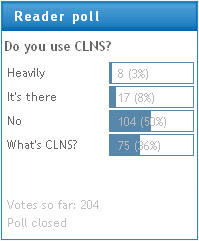
Let's start with the acronyms. CLNS (Connection-Less Network Service) in combination with CLNP (Connection-Less Network Protocol) is the ISO (International Standards Organization) equivalent to IP.
Almost-Dynamic Routing over ADSL Interfaces
Recently I had to implement Internet access using ADSL as the primary link and ISDN as the backup link. Obviously the most versatile solution would use the techniques described in my Small Site Multi-homing articles, but the peculiarities of Cisco IOS implementation of the ADSL technology resulted in a much simpler solution.
IOS implementation of PPPoE links uses dialer interfaces. However, the “dialing” on these interfaces is activated as soon as the underlying PPPoE session is active (before the first interesting packet is routed to the interface). When the simulated dial-out occurs, the router starts PPP negotiations including the IPCP handshake, which usually results in an IP address assigned to the dialer interface. Net result: if the dialer interface has an IP address, the PPPoE session is obviously active (and vice versa).
OSPFv3 Router ID: the Long Shadow of IPv4
One of the obscure facts about IPv6 OSPF (OSPFv3) is that it uses a 32-bit router ID like OSPFv2. It’s a reasonable choice; I have yet to see an OSPF network with over a billion routers. However, could you guess how this requirement is implemented in Cisco IOS? OSPFv3 searches for an IPv4 address (effectively the same algorithm used by OSPFv2) to get the router ID for the IPv6 routing process. Neat, isn’t it?
You might wonder what happens if you want to configure an IPv6-only router. OSPF won’t start unless you configure the router ID manually. And, no, you cannot enter a number (which would be the expected format, as the router ID is just a number in the IPv6 world); you have to enter an IPv4 address. Long live IPv4 :))
Subnet Masks in OSPF Network Statements
In a comment to my recent NTP-related post mentioning OSPF configuration, Wan Tajuddin correctly stated that the OSPF network statement should contain the wildcard bits, not the subnet mask. However, I was positive I had running networks with the network 0.0.0.0 0.0.0.0 area 0 OSPF configuration, so it was time for one more lab test. As it turns out, Cisco IOS started accepting either the wildcard bits or the subnet mask in the network OSPF configuration command.
Technology Is Supposed to Be Simple, Right?
In his comment to the one of my NTP articles, Joe said:
This is part of the problem with NTP. It's way more complicated then it needs to be. You shouldn't have to understand so much of it to use it on your routers. Take a look at openntpd. It's free and runs on bsd or linux.
I have to disagree with him on several counts:
BGP Essentials: Non-transit AS
One of the first things you have to do when configuring BGP with your ISP is to ensure you won’t become a transit AS. Decent ISPs filter out things that don’t belong to you from your updates, but not everyone cares (including some really big names), and so small organizations manage to bring down large parts of the Internet just with a few fat fingers.
Here’s the BGP configuration you should use on Cisco IOS: apply AS-path access-list to outbound updates with neighbor filter-list command:
Use UDP flood to increase router's CPU load
If you want to test the ERM policies in a controlled environment, it's almost mandatory to have tools that allow you to overload the router. One way to overload a router is to flood it with UDP packets. Flooding a router's IP address, you're guaranteed to raise the CPU to 100%, with majority of the process CPU being used by the IP Input process (the interrupt CPU load will also be significant).
This phenomenon illustrates very clearly why it's so important to have inbound access lists protecting the router's own IP addresses on all edge interfaces.