
Ethernet inter-frame gap: Another living fossil?
Recently I’ve stumbled across a year-old post by James Ventre describing the reasons output rate on an Ethernet-type interface (as reported by the router) never reaches the actual interface speed. One of them: inter-frame/packet gap (IPG).
I was stunned ... I remember very well the early days of thick/thin coax Ethernet when the IPG was needed for proper carrier sense/collision avoidance detection (probability of a collision decreases drastically as you introduce IPG), but on a high-speed point-to-point full duplex link? You must be kidding.
DMVPN: from Concept to Pilot in 36 Hours
Participants of my webinars might remember the concept of on-site workshops that I kept mentioning until the COVID-19 pandemic brought my in-person business to a halt. Almost a decade before that calamity, the networking team from a large multinational company had decided to test it in practice and invited me for a 3-day DMVPN workshop.
The agenda of these workshops is usually pretty simple:
- Day 1: technology overview and review of the existing network design/challenges.
- Day 2: work on proposed new network design.
- Day 3: tying up loose ends and preparations for pilot/migration.
We agreed on a tentative agenda along these lines and I prepared the material for the technology overview using parts of my Choose the Optimal VPN Service webinar (to compare DMVPN with other VPN solutions) and the DMVPN webinar. Oh boy, was I in for a surprise.
Multiple EIGRP Autonomous Systems in a VRF
A while ago Ron sent me an intriguing question: “Is it possible to have two EIGRP AS numbers in the same VRF?” Obviously he’s working on a network with multiple EIGRP processes (not an uncommon pre-MPLS/VPN solution; I did a network design along the same lines almost 20 years ago).
It’s easy to run multiple EIGRP autonomous systems in the global IP routing table; just create more than one EIGRP process. They can even run over the same set of interfaces. EIGRP-in-a-VRF implementation is slightly different; you configure an address family within another EIGRP process and (optionally) specify an AS number that does not have to match the AS number of the EIGRP process.
Interesting links (2010-10-03)
Ethan Banks is continuing his deliberations on going independent (or not). He’s definitely collected some very interesting feedback.
Stephen Foskett shared a link to an interesting blog post: “How to Pitch A Tech Blogger”. A must read for vendors attending Tech Field Day (have you noticed there is no mention of Gartner or IDC? ;)
Another great read from Stephen: a large dose of common sense hidden under the “Four Fundamental Best Practices for Enterprise IT” title. I wonder if the vendors touting TRILL and inter-DC bridging with long-distance vMotion ever got to the “Minimize Complexity” part, let alone “Align Expectations with Reality”.
… updated on Sunday, May 8, 2022 09:21 UTC
Multi-Chassis Link Aggregation (MLAG) Basics
If you ask any networking engineer building layer-2 fabrics the traditional way about his worst pains, I’m positive Spanning Tree Protocol (STP) will be very high on the shortlist. In a well-designed fully redundant hierarchical bridged network where every device connects to at least two devices higher in the hierarchy, you lose half the bandwidth to STP loop prevention whims.
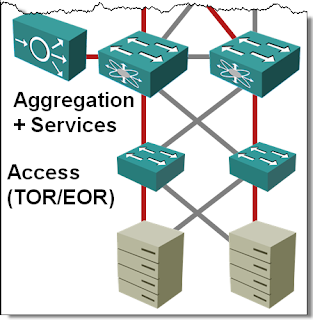
Introduction to 802.1Qaz (Enhanced Transmission Selection – ETS)
Enhanced Transmission Selection (ETS) is the second part of the Data Center Bridging puzzle (I’ve already described Priority Flow Control). It specifies two different technologies:
- Queuing mechanisms in bridges
- Data Center Bridging eXchange protocol: a Control/Negotiation protocol that allows bridges and hosts to negotiate QoS parameters in a bridged network.
Although some bridges from some vendors supported numerous QoS mechanisms in the past, 802.1Qaz is the first attempt to standardize a richer set of QoS behaviors than the strict priority queuing defined in 802.1p.
FCoE Quote-of-the-Day
“Use FC where you feel you need to, use Ethernet (NFS, CIFS, iSCSI) everywhere else -- and save money and effort in the process”
Etherealmind and myself have been singing this song for quite some time (probably upsetting a few people working for my favorite vendor), but this time it comes straight from EMC’s CTO. And he didn’t even mention FCoE in his list of storage protocols.
What exactly is a Nexus 4000?
Someone mentioned a while ago in a comment to one of my blog posts that the Nexus 4000 switch already supports multihop FCoE. Now that we know what multihop FCoE really is, let’s see how Nexus 4000 fits into the picture.
The Cisco Nexus 4000 Series Design Guide starts with a confusing set of claims:
- The Cisco Nexus 4000 Series Switches provide the Fibre Channel Forwarder (FCF) function.
- Nexus 4000 is a FCoE Initialization Protocol (FIP) snooping bridge.
ATAoE: response from Coraid
A few days after writing my ATAoE post I got a very nice e-mail from Sam Hopkins from Coraid responding to every single point I’ve raised in my post. I have to admit I’ve missed the tag field in the ATAoE packets which does allow parallel requests between a server and a storage array, solving some of the sequencing/fragmentation issues. I’m still not convinced, but here is the whole e-mail (I did just some slight formatting) with no further comments from my side.
DMVPN: Non-Unique NHRP Registrations
During my last DMVPN webinar, one of the students mentioned the need for non-unique NHRP registrations in environments where the public IP address of a DMVPN spoke site changes due to DHCP lease expiration or PPPoE session termination. Finally I found some time to recreate the scenario in my DMVPN lab; here are the results.