
BGP Best External Explained
Loads of niche features got crammed into (MP)BGP and MPLS since I wrote my MPLS books, most of them trying to tweak BGP (a scalable and reasonably slow routing protocol dealing with behemoth tables) to behave more like an IGP would.
It looks like we’ll never see updated versions of the books, so I’ll try to cover the new features with short videos. The first one on the list: BGP Best External – a mechanism that speeds up MP-IBGP convergence in primary/backup PE-CE scenarios using EBGP.
Optimal L3 Forwarding with VARP and Active/Active VRRP
I’ve blogged about the need for optimal L3 forwarding across the whole data center in 2012 when I introduced it as one of the interesting requirements in Data Center Fabrics webinar. Years later, the concept became one of the cornerstones of modern EVPN fabrics, but there are still only a few companies that can deliver this functionality in a more traditional environment.
Could IXPs Use OpenFlow to Scale?
The SDN industry probably considers me an old and grumpy naysayer (and I’m positive Mrs Y has a special place in their hearts after her recent blog post), so I tried really hard to find a real-life example where OpenFlow could be used to solve mid-market innovator’s dilemma to balance my usual OpenFlow and SDN presentation.
Hyper-V 3.0 Extensible Virtual Switch
It took years before the rumored Cisco vSwitch materialized (in the form of Nexus 1000v), several more years before there was the first competitor (IBM Distributed Virtual Switch), and who knows how long before the third entrant (recently announced HP vSwitch) jumps out of PowerPoint slides and whitepapers into the real world.
Compare that to the Hyper-V environment, where we have at least two virtual switches (Nexus 1000V and NEC's PF1000) mere months after Hyper-V's general availability.
Published on , commented on July 10, 2022
OpenFlow and SDN – Do You Want to Build Your Own Racing Car?
The OpenFlow zealots are quick to point out the beauties of the centralized control plane, and the huge savings you can expect from using commodity hardware and open-source software. What they usually forget to tell you is that you also have to reinvent all the wheels the networking industry has invented in the last 30 years.
Celebrating 40 years of Ethernet ... at south pole
Did you know Ethernet turned 40 today? I didn't (I was never good at tracking anniversaries), but Kris Amundson (the engineer keeping his network up and running in pitch dark Antarctica) quickly brought it to my attention with wonderful photos of South Pole Ethernet network built @ -69C (that's -92F if you're still ignoring the metric system).

Even better, they still have a thick coax cable with transceiver screwed into it!
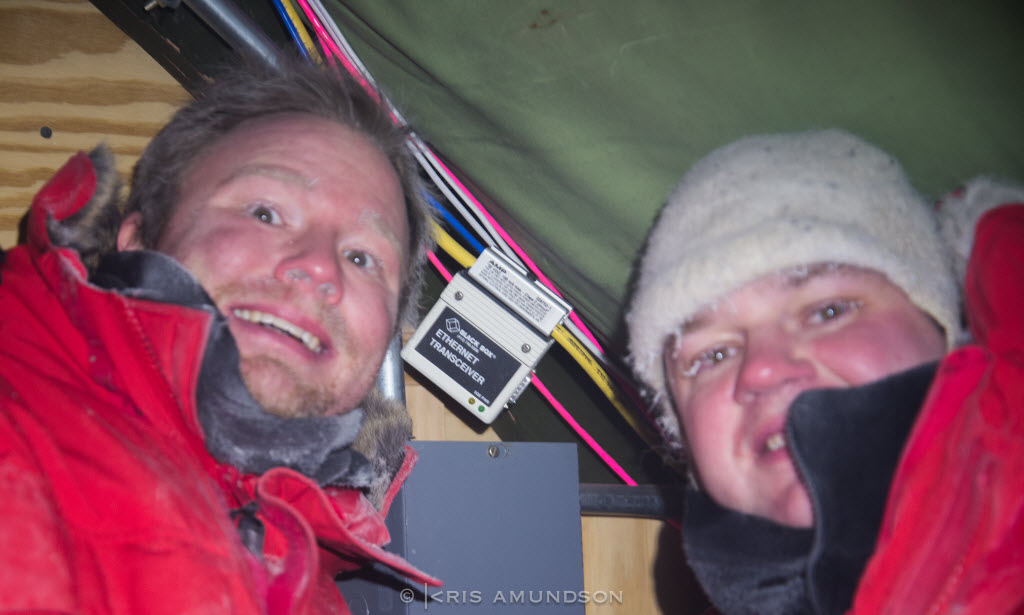
Thanks for sharing, Kris! Really appreciated ;)
The Dangers of Ignoring IPv6
I was sitting next to a really nice security engineer during the fantastic dinner-in-a-wine-cellar @ Troopers 13 and as we started talking about security implications of ignoring IPv6, I was quickly able to persuade him that it's dangerous to pretend IPv6 doesn't exist and that even though you might choose not to deploy it, you still have to acknowledge it exists and take protective measures.
It’s always great fun to explain the dangers of ignoring IPv6 to a networking or security audience, and see some people muttering “oh, ****”
Multi-Vendor OpenFlow – Myth or Reality?
NEC demonstrated multi-vendor OpenFlow network @ Interop Las Vegas, linking physical switches from Arista, Brocade, Centec, Dell, Extreme, Intel and NEC, and virtual switches in Linux (OVS) and Hyper-V (PF1000) environments in a leaf-and-spine fabric controlled by ProgrammableFlow controller (watch the video of Samrat Ganguly demonstrating the network).
Does that mean we’ve entered the era of multi-vendor OpenFlow networking? Not so fast.
Troopers 13 – a must-visit security conference
If you live in Europe and happen to be interested in security, make sure you put Troopers on the list of must-attend events. Like many things coming from Europe it’s a boutique event (limited to 200 attendees even if it means it’s sold out – that would never happen in some other parts of the world) with some great content.
Enno Rey, the mastermind behind the event, was kind enough to invite me to talk about virtual firewall architectures – you can view my presentation or watch the video – and of course I used the opportunity to visit a not-so-well-known Heidelberg attraction ;)
Expert Beginners
Erik Dietrich obviously hates the self-proclaimed (usually clueless) “experts” – he devoted a whole series of blog posts to them:
- Rise of the Expert Beginner
- Legacy of the Expert Beginner
- Language of the Expert Beginner
- Ambitions of the Expert Beginner
I’m positive you know at least a few people that would match his descriptions. Enjoy!