
Compress netlab Lab Topologies with Dot Notation
netlab is using the Python Box library to make the code easier to read1. When I started the project, I hated the way you fetch values from Python dictionaries with stuff like node['ospf']['area']; Python Box lets you write node.ospf.area. Even better2, you can tell Python Box to create intermediate dictionaries as needed. node.ospf.area = 1 will automatically create the node.ospf dictionary.
But wait, there’s more (yes, we’re getting to the topic of today’s blog post): Box lets you use the same dotted notation in YAML files.
On ACLs and AI-Generated Device Configurations
Last Friday, I had a lovely chat with Steinn Bjarnarson and Urs Baumann, resulting in the NetworkAutoMagic episode 11. We couldn’t avoid mentioning netlab, the seven layers of ACL hell (which is still balmy compared to the QoS hell), and the gotchas of AI-generated device configurations.
Fortunately, I don’t have to go into more details; Steinn published extensive notes, and if you don’t feel like listening to us while driving, you can waste time watching us on YouTube.
netlab 26.08: ArcOS, VPP (FD.io), ACLs, and DNS
netlab release 26.08 brings a few humongous additions:
- ArcOS support by @roc-ops
- VPP (FD.io) with FRR or BIRD control plane by @jbemmel
- SONiC containers (also by @roc-ops)
- IPv4/IPv6 access control lists in the routing module by @DanPartelly
But wait, there’s more:
On the Futility of Opening Ansible Issues
Remember the anonymous troll who chided me for writing a rant instead of opening a GitHub issue in the relevant Ansible repository? Well, I decided to be an open-source poster boy when I stumbled upon the next Ansible bug, and ended up feeling like a sweet summer child :(
Content: New Parameter in Multiple something_config Ansible Modules
Last December, I wrote a pretty ranty post explaining how Ansible release 12 broke (some?) network device configuration playbooks. The inevitable anonymous troll (why are they always anonymous?) couldn’t resist asking whether I opened an issue on GitHub. I didn’t (more about that later), but when the solution to that rant was “we’re deprecating using templates in src” parameter, I opened an issue arguing why that’s not a good idea.
Worth Reading: Git Oh-Shit Toolkit
Tony Mattke published a blog post I wish I’d read 10 years ago. His Oh-Shit Toolkit includes several tools one can use after messing up Git branches or commit history.
Definitely worth reading, even if you’ve been working with Git for ages.
netlab 26.07: GRE, Wireguard, Graceful Restart, and Scale-Out Labs
The highlights of netlab release 26.07 include:
- The multiserver plugin by @muddyblack distributes containerlab devices across multiple servers.
- The GRE tunnel plugin supports GRE tunnels on Cisco IOS, FRR, VyOS, and Junos (vSRX and vJunos-router) (most device implementations done by @ssasso and @jbemmel).
- The WireGuard tunnel plugin by @jbemmel supports WireGuard tunnels on FRR.
- The bgp.session plugin and the OSPF module support graceful restart on Arista EOS, BIRD, FortiOS, and FRR (by @jbemmel and @a-v-popov)
- The bgp.policy plugin supports the bgp.role attribute on FRR and BIRD (by @jbemmel).
But wait, there’s more ;)
netlab: 2000 Pull Requests Later ;))
Jeroen van Bemmel noticed an interesting fact yesterday evening: the netlab GitHub repository has 2000 merged/closed pull requests. I never expected the tiny “let’s learn Python while working around the complexities of Vagrantfile” project to get this far ;))
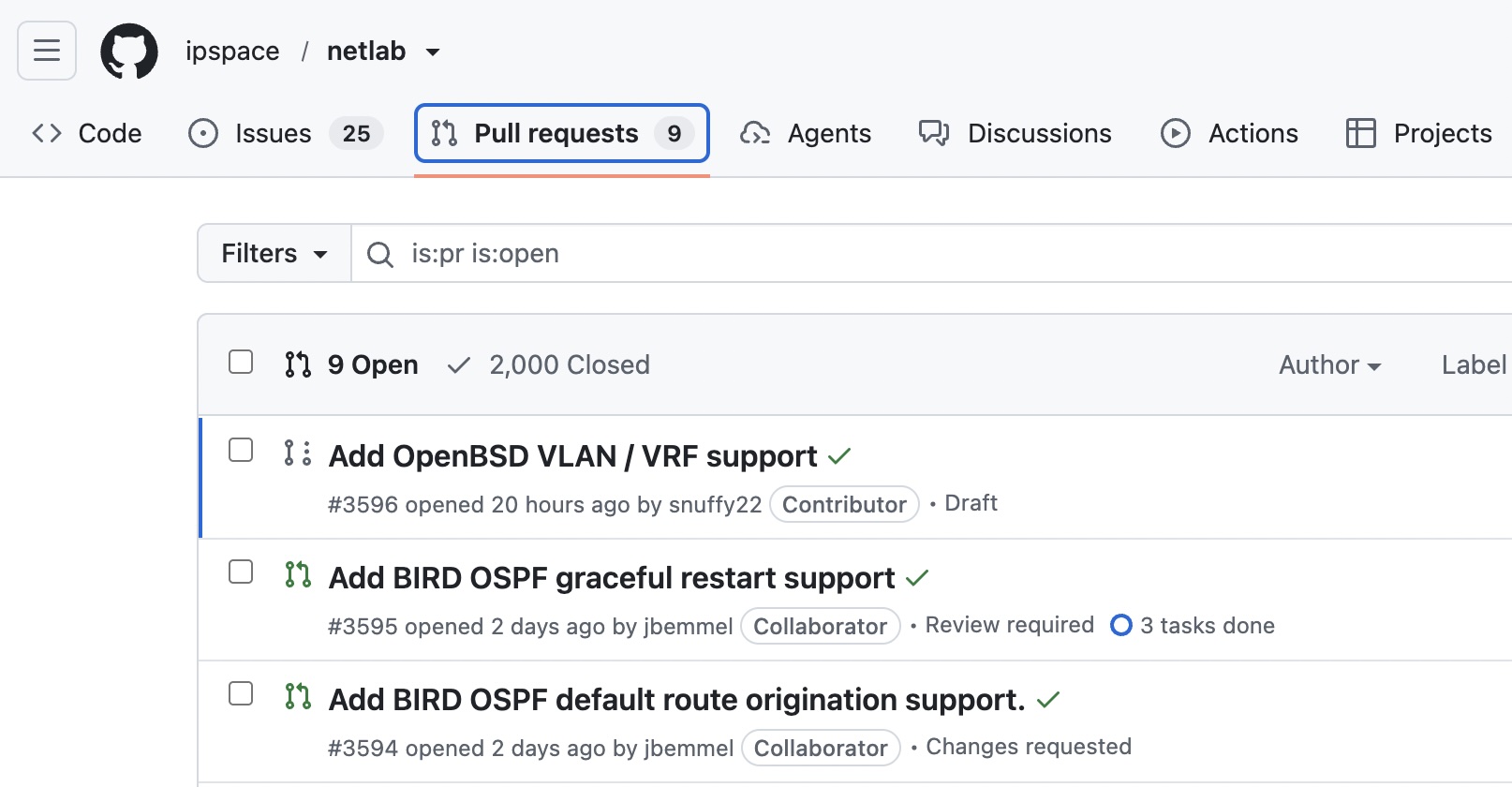
Thanks a million to everyone who contributed, reported a bug, asked a question, or helped us spread the word. You rock 🤗
Worth Reading: Scripting Good Practices in Python
Just in case you decide to build a simple Python project over the summer: read scripting good practices in Python by Brett Cannon and tell your AI friend to adhere to them ;)
Worth Reading: More VXLAN and EVPN Labs
Ali Bahadır Coşkun continued his EVPN/VXLAN journey. Using the free netlab-powered EVPN/VXLAN labs, he finished the basic EVPN/VXLAN lab (adding EVPN control plane to VXLAN underlay), and then completed the whole VXLAN/IRB/anycast saga.
Want to do something similar? The free EVPN/VXLAN lab exercises include six VXLAN labs, almost a dozen EVPN labs, and a few EVPN designs. I might add a lab or two during the summer break.