
Does It Make Sense to Build Your Own Networking Solutions?
One of my readers was listening to the Snabb Switch podcast and started wondering “whether it’s possible to leverage and adopt these bleeding-edge technologies without a substantial staff of savvy programmers?”
Short answer: No. Someone has to do the heavy lifting, regardless of whether you have programmers on-site, outsource the work to contractors, or pay vendors to do it.
Awesome Response: Complexity Sells
Russ White wrote an awesome response to my Complexity Sells post:
[…] What we cannot do is forget that complexity is real, and we need to learn to manage it. What we must not do is continue to think we can play in the land of dragons forever, and not get burnt. […]
Now go and read the whole blog post ;)
Build Your Own Service Provider Gear on Software Gone Wild
A few days after I published a blog post arguing that most service providers cannot possibly copy Google’s ideas Giacomo Bernardi wrote a comment saying “well, we managed to build our own gear.”
Initially I thought they built their own Linux distribution on top of x86 server, but what Giacomo Bernardi described in Episode 59 of Software Gone Wild goes way beyond that:
Optimize Your Data Center: Reduce the Number of Uplinks
Remember our journey toward two-switch data center? So far we:
Time for the next step: read a recent design guide from your favorite hypervisor vendor and reduce the number of server uplinks to two.
Not good enough? Building a bigger data center? There’s exactly one seat left in the Building Next Generation Data Center online course.
Directed ARP Saga Continues
Reading my Directed ARP and ICMP Redirects blog post you might have wondered “how did Directed ARP ever get into ***redacted***?”
I searched for “directed ARP cisco” and found this gem, which really talks about unicast ARP behavior, an ancient mechanism documented in RFC 1122 (it’s not my Google-Fu, I got the reference to RFC 1122 in this blog post).
On the Lossiness of TCP
When someone tells you that “TCP is a lossy protocol” during a job interview, don’t throw him out immediately – he was just trusting the Internet a bit too much (click to enlarge).
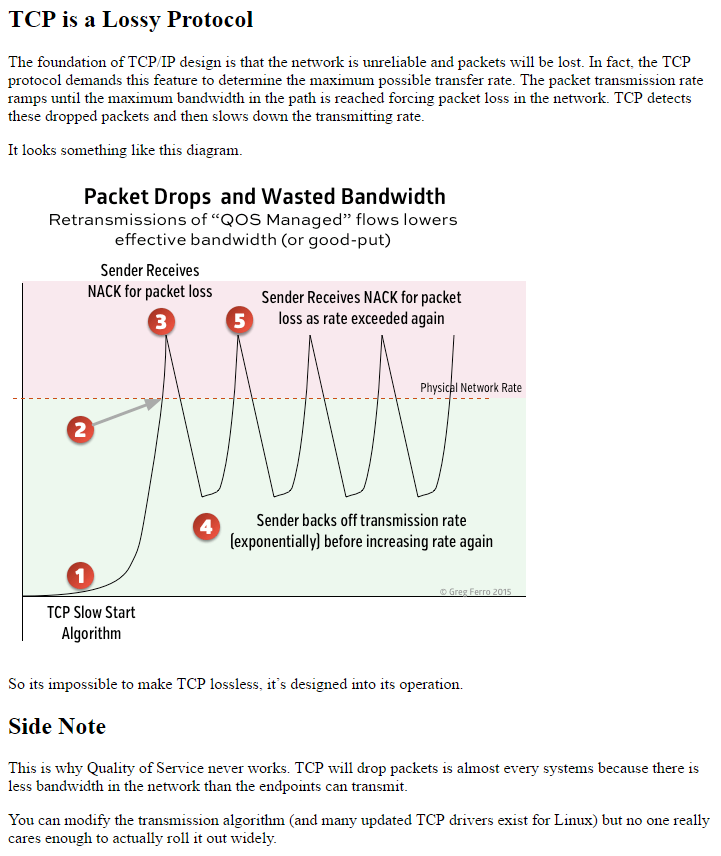
Everyone has a bad hair day, and it really doesn’t matter who published that text… but if you’re publishing technical information, at least try to do no harm.
Where Is the Explosion of Overlay Virtual Networks
Three years ago I was speaking with one of the attendees of my overlay virtual networking workshop @ Interop Las Vegas and he asked me how soon I thought the overlay virtual networking technologies would be accepted in the enterprise networks.
My response: “you might be surprised at the speed of the uptake.” Turns out, I was wrong (again). Today I’m surprised at the lack of that speed.
Big Chain Deep Dive on Software Gone Wild
A while ago Big Switch Networks engineers realized there’s a cool use case for their tap aggregation application (Big Tap Monitoring Fabric) – an intelligent patch panel traffic steering solution used as security tool chaining infrastructure in DMZ… and thus the Big Chain was born.
Curious how their solution works? Listen to Episode 58 of Software Gone Wild with Andy Shaw and Sandip Shah.
Complexity Sells
A blog post on Packet Pushers contained a quote by E. W. Dijkstra (of the SPF fame) and while trying to figure out whether that quote was real I stumbled upon his keynote address from a 1984 ACM conference (original). Not surprisingly, nothing has changed in the last 30+ years…
Directed ARP and ICMP Redirects
One of my readers sent me this question:
When I did my ***redacted*** I encountered a question about Directed ARP. The RFC (https://tools.ietf.org/html/rfc1433) is in the "experimental" stage, and I found it really weird from ***** to include such a hidden gem in the ***redacted***.
Directed ARP is clearly one of those weird things that people were trying out in the early days of networking when packet forwarding and bandwidth were still expensive (read the RFC for more details), but I kept wondering “what exactly is going on when a host receives an ICMP redirect?” Time for a hands-on test.