
Testing IP Multicast with netlab
Aleksandr Albin built a large (almost 20-router) lab topology (based on an example from Jeff Doyle’s Routing TCP/IP Volume 2) that he uses to practice inter-AS IP multicast. He also published the topology file (and additional configuration templates) on GitHub and documented his experience in a LinkedIn post.
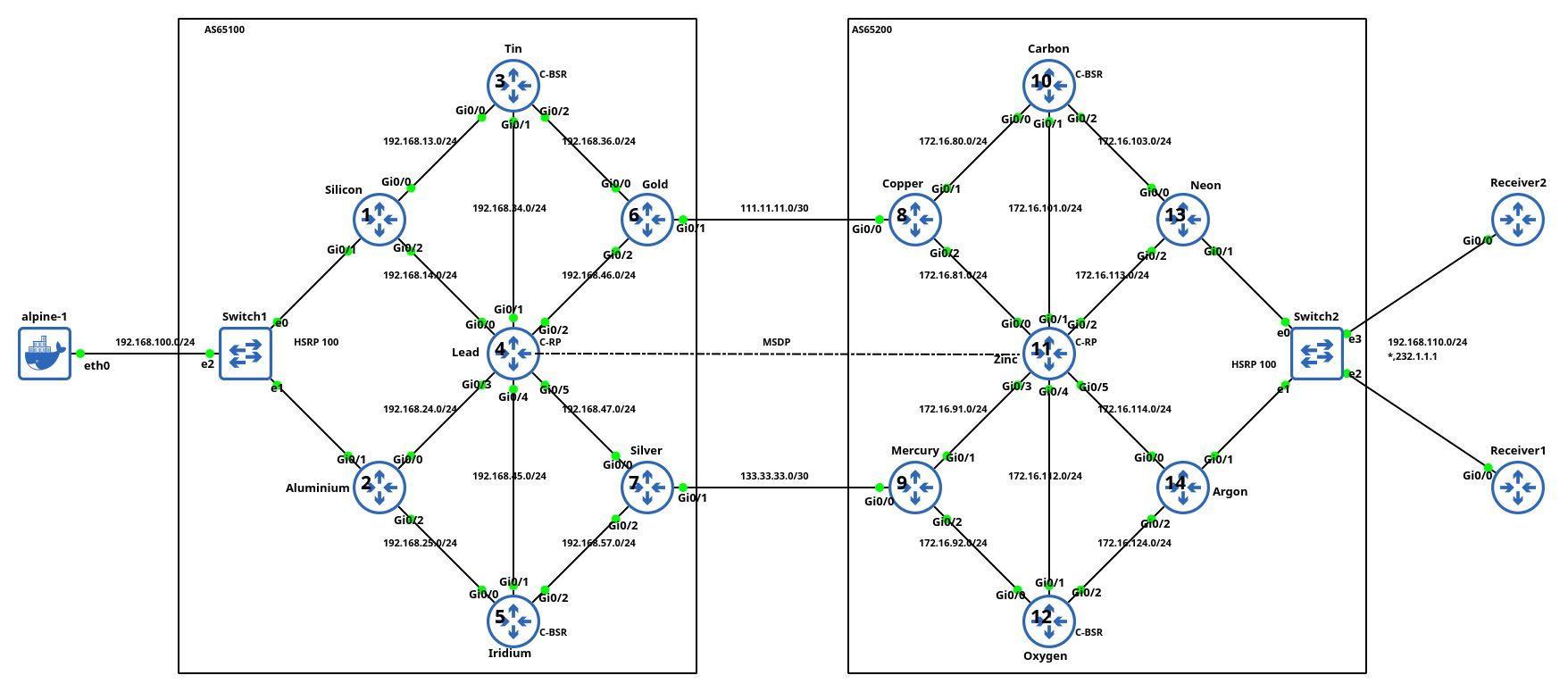
Lab topology, copied with permission by Aleksandr Albin
It’s so nice to see engineers using your tool in real-life scenarios. Thanks a million, Aleksandr, for sharing it.
-adding failure & recovery scenarios to see multicast if the traffic is rerouted, and how quickly (very important when you use multicast for real time communication)
-using topology where we could see some example of 'corner cases' like FHR (the router facing the source) is the same as the LHR(the router facing receivers) - this can be really interesting
-testing the moving source of the multicast i.e. the host sourcing the multicast move to different part of the tree (nothing unique in mobile networks I work with)
Academic style examples like the mentioned ones are good for students of course.
Every major router vendor claims that they mastered the multicast technology before entering the true multicast business;)
Thank you, Bogdan. Would you be so kind and provide topologies and initial configs for the exercises you suggested?
I work for Tetra & Astro business (kind a mobile networks targeted for public safety).
Moving multicast source. I would try from two router topology where router a is an RP router for PIM-SM mode. So you need to enable this capability on a router A and in simple case you need to point out this RP service on a router B. Establish multicast communication from LAN segment attached to the router B and receivers connected to a router B. Once working start to generated multicast from a source attached to B. Preserve multicast group (and stop sourcing multicast from a a segment attached to A). This scenario reflects moving source (kinda BTS roaming where BTS is packetizing audio from a mobile radio). I know it's complex scenario but real in some kind of networks.
Single router corner cases. In this scenario FHR = LHR. It resembles the second part of the excercise 1. Why interesting? Because you cannot see PIM-REG encap packets as the host sourcing multicast is directly connected to the RP. Still thinking about PIM-SM here.
Add redundancy. Dual routers potentially delivering multicast for a segment. Test cases when DR crashes. Sniff how many packets are lost. The networks I work with need to re-converge within max 1.5sec. Seems to be easy. But not for budget-constrained solutions.
The scenarios about at his basic level can be configured but enabling PIM-SM, static RP config + PIM Anycast for the redundancy purpose.
I know it is pretty unique purpose but challenging.
Thank you, Bogdan.
Thank you!